

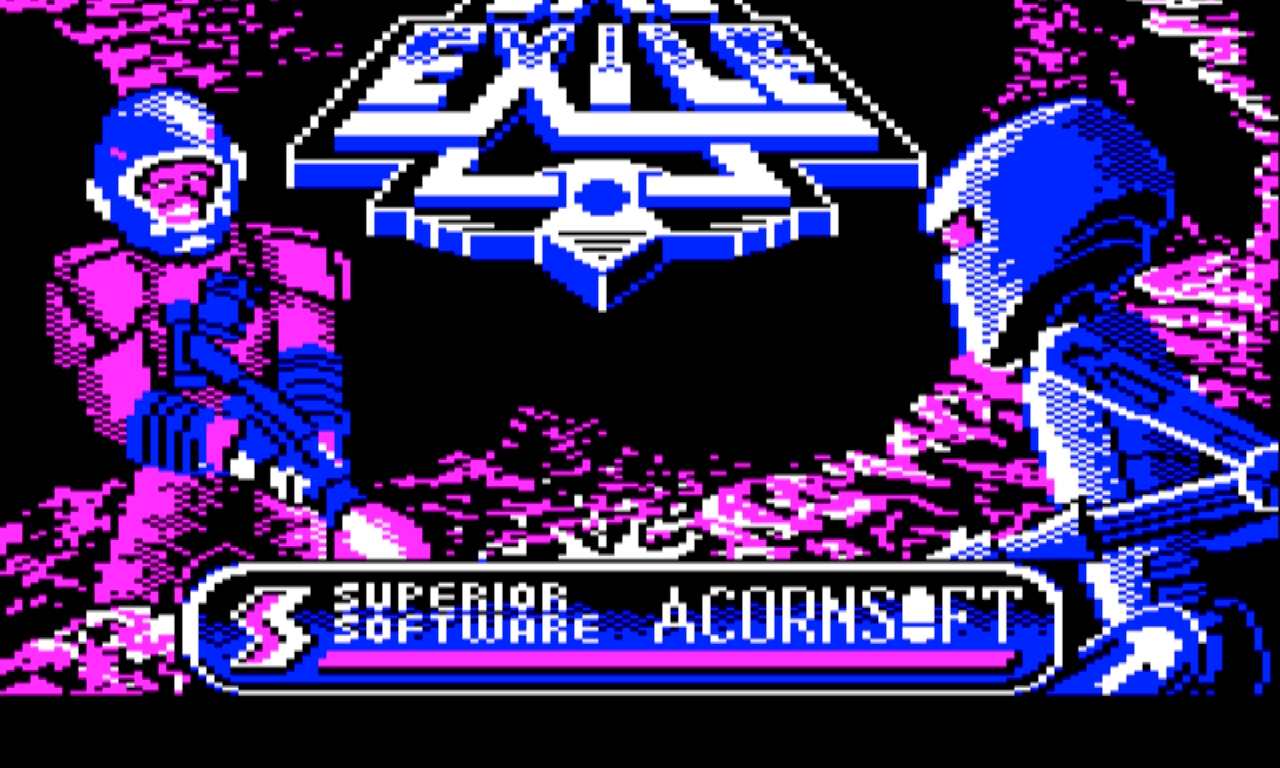
In June 1991, during the waning years of the Commodore 64, I picked up my regular issue of Commodore Format, the last great magazine devoted to the format during its commercial life.
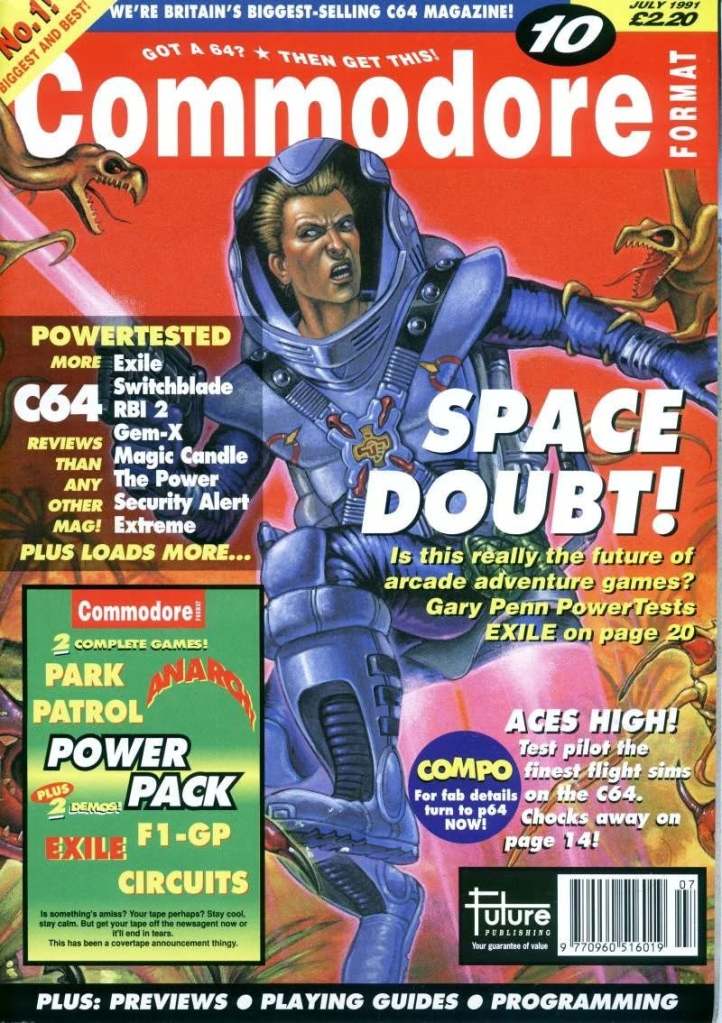
On its cover tape was a demo for the star of this article: Exile. I’d never heard of the game before or had any idea of its BBC Micro lineage. But when I fired it up, I was amazed to find myself in a space adventure the likes of which I’d never experienced before.
Ground Control to Mike Finn, Spaceman.
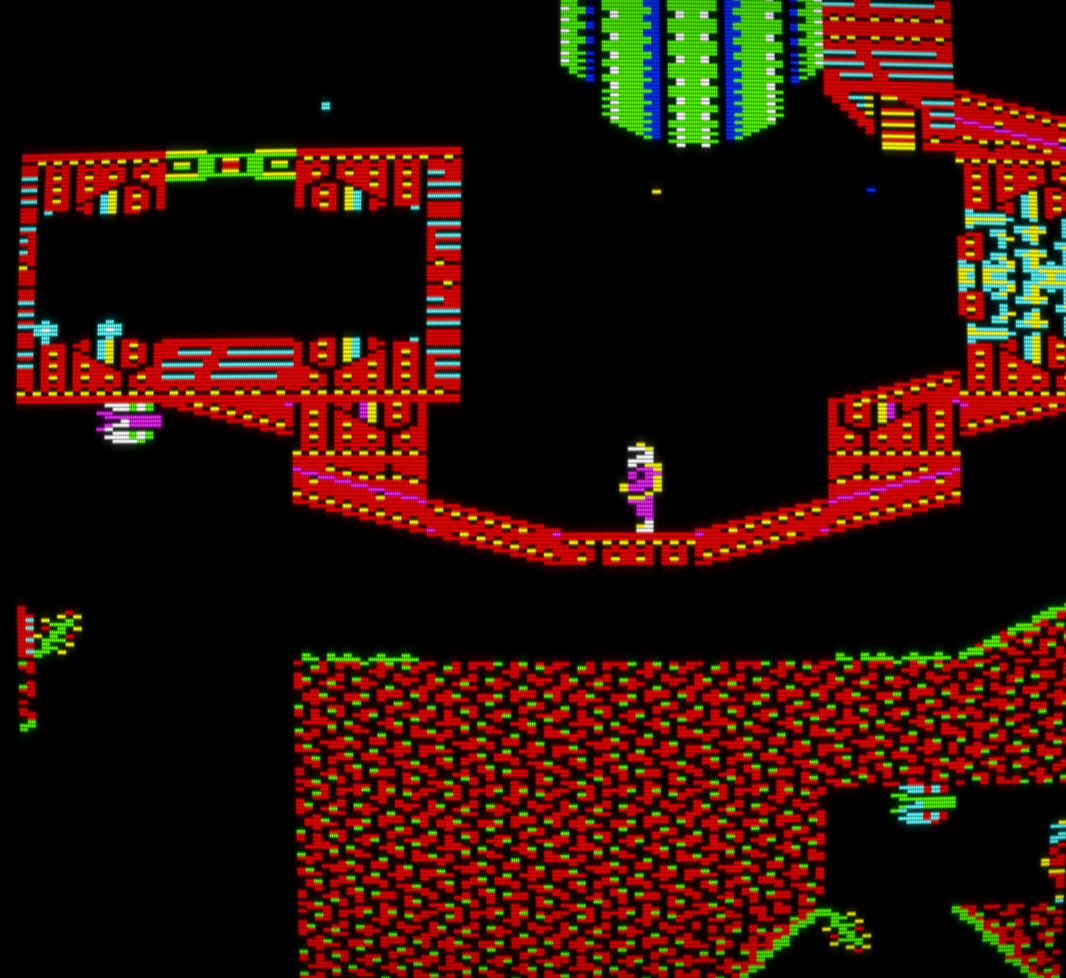
I’ll be showcasing screenshots from the original BBC Micro version, as it’s an astonishing technical achievement and quite lovely to look at. Given my general memories of playing educational software on ‘The Beeb’ with chunky, primitive graphics, I’m especially impressed. Due to technical limitations making the displaying of a UI impossible, it is also (likely unintentionally) the most immersive, giving you a full-screen view of its sprawling, 2D open world. In place of the energy bars and number displays on the UI present in other versions, the BBC version conveys that information via other visual and audio cues.
The game puts you into the space-boots of Mike Finn, who has answered the distress call of a colony ship touched down on the planet Phoebus. Turns out, they had the misfortune of landing on a world serving as, well, the place of EXILE for a notorious genetic engineer, Dr Triax, and were promptly captured and turned into biological horrors. Mike, being the heroic sort, has taken it upon himself to take down Triax once and for all!
Making things challenging right away is the fact that Exile employs a full Newtonian physics system. Everything in the game has a certain weight and mass, including Mike. And it’s all affected by the planetary environment. Wind, heat, gravity, momentum, inertia, and even water pressure are all modelled—even on the original BBC Micro version and with just 32 KB of RAM to play around with.
Mike gets around on both his own two legs and via a jetpack. And this here is another challenge you must overcome: moving around without tripping over or sending yourself careening over a ledge or into a wall.
In some ways, it’s almost a precursor to games like QWOP. You must be careful and precise in your choice of movement and control of Mike. Apply too much thrust from his multi-directional jet pack in any one direction, and you’ll rocket away in that direction and need to either flip around and thrust back in the opposite direction or apply counter-thrust. And because realistic momentum is a thing, you won’t come to an immediate halt. Well, unless you slam into a wall, rock, or bulkhead. In which case you’ll take impact damage—sometimes enough to kill you depending on how high your velocity is.
It still fills me with wonder now to move Mike about, marvelling at just how the game code is calculating away in the background. Part of its ability to do so comes down to the prior experience of one of its designers, Jeremy C. Smith. Jeremy was the brains and talent behind 8-bit microcomputer classic Thrust.
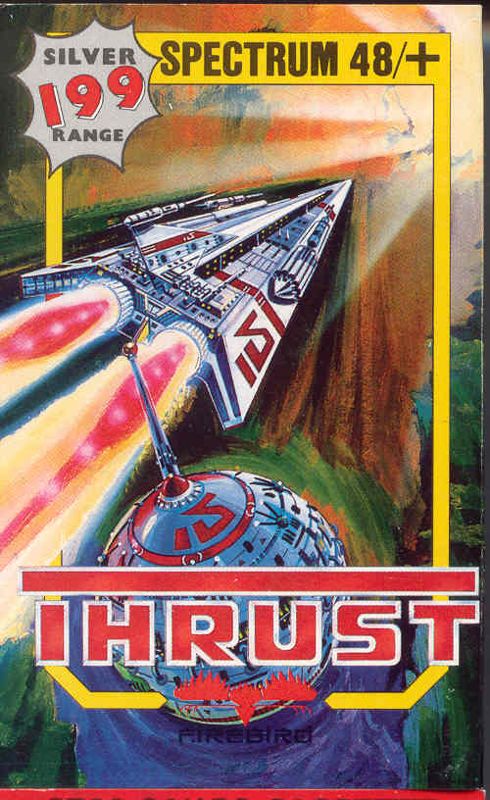
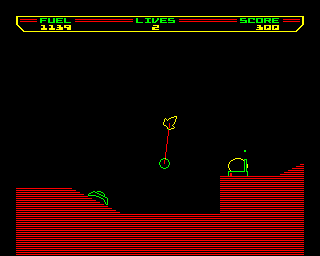
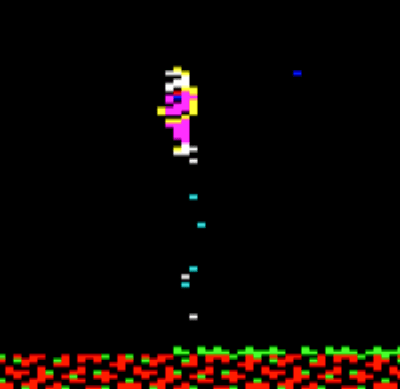
Like Exile, Thrust challenges you to master realistic thrust, mass, and weight as you navigate labyrinthine mazes, tethering yourself to orbs and carrying them back the way you came.
It’s one of those things that makes you go ‘Ohh, that makes so much sense’, when you learn that the Thrust guy co-developed Exile. It’s an evolution of the ideas presented in Thrust, just on a much grander scale and exploring game concepts and mechanics that, in recent years, have led to Exile being classified as an early ‘Metroidvania’.
Mind Where You Throw That Thing Around, Young Spaceman.
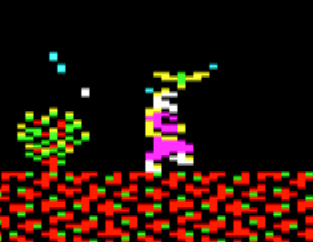
After you get to grips with basic movement and manage to leave your spacecraft, you’ll get four early demonstrations of Exile‘s physics system. The first is the wind that blows if you go too far in either direction, pushing you back. You can counter the velocity of the wind early on with enough thrust, but eventually, the wind speed will be too great. The second is a native bird-like lifeform which will home in on you and start knocking you about. Not out of hostility, but out of curiosity.
To add to its list of impressive achievements, Exile has an ecosystem. You’ll come into contact with various lifeforms, both organic and robotic. Relatively few are actively hostile, but even when they aren’t, they all have the potential to cause you all kinds of mischief: pushing you about, stealing from you, or knocking items out of your hands when you’re carrying them.
The first item you’ll pick up (and need to progress) is a grenade, resting on the ground to the east of your starting location. You’ll pick it up with a key press and then can either store, drop, throw, or prime it. Woe betide you if the bird flies into you while you’re carrying it and accidentally primes it to explode! Or knocks it out of your hands as you prime it and prepare to throw it! And if the wind is blowing back at you sufficiently hard, it’ll blow the grenade back towards you.
You’ll need this grenade to blow open a set of pressure doors.
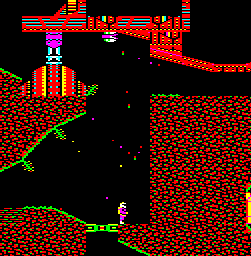
Before you reach them, a hostile turret will be guarding the entrance to Triax’s underground domain—the first enemy you face. And it will open fire with bullets that also have their own physics, ricocheting off terrain in a hail of particle effects that’s as dazzling as it is deadly.
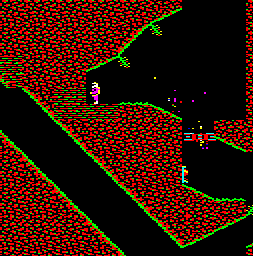
You’ll need to throw or drop the primed grenade onto or close enough to the bulkhead door to destroy it, all while dodging a hail of bouncing, exploding bullets from the overhead turrets. And if you’re too close to the blast when the grenade explodes, it’ll take you out too. Thankfully, you’re given an invaluable aid to assist you: the ability to set teleport points and recall to them at will.
Mike’s ability to teleport is a literal lifesaver in more ways than one. It also factors into the merciful lack of lives in the game. If Mike takes too much damage, he’ll be auto-teleported out of harm’s way to the last recall point or back to the start point on his ship, albeit battered and semi-conscious and needing time to recover.
The fact that you can’t die (though you can still end up in no-win scenarios if certain key items and resources get destroyed or lost) takes a lot of the pressure off what could otherwise be a frustrating experience given how much random chaos can erupt. You can immerse yourself in Exile‘s world at your leisure, playing around in the physics sandbox and exploring what makes it tick.
That’s what I did with that demo of the C64 version, unaware of a greater plot and mission. Not since Pitfall II had I been presented with a world that felt so open that anything could be out there, waiting to be found. Every bit of progression I managed to achieve felt so satisfying, as was mastery of the game’s physics. At first, I couldn’t move Mike around without unceremoniously flopping over, nor navigate narrow tunnels without bouncing off them. But as I learned to play by its rules—how much thrust to apply in which direction, where to aim a rock to hit X wall to bounce it into Y hole and hit Z button—it became second nature.
An Underground World of Mischief, Peril, and Wonder
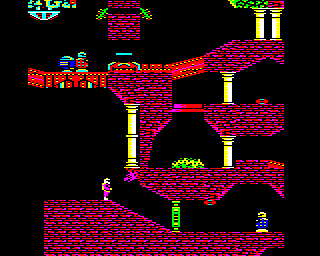
Exile has no separate levels/stages, just one contiguous environment. You’ll go deeper and deeper into the depths of the planet over the course of your mission to take down Triax, encountering more of its ecosystem along the way. Playful imps will swarm you, offering and accepting trades of mushrooms and, occasionally, stealing items from you. Gravity-affecting giant clams will open their shells, shaking the screen and either dragging you towards them or pushing you away. Alien bees will be both a menace and an occasional puzzle-solving tool. Robots will trundle along its corridors of alien brick and stone, some of which you’ll learn to control. You’ll also need to carry water in glass beakers for some environmental puzzles, such as putting out flames blocking your way. Do so carefully, because water is, of course, a liquid and thus can spill out if you jostle the beakers too much.
The more I gush about Exile and how much it’s doing all at once, the more amazing it seems that it was achieved in 1988 and with just 32 KB. Developers Jeremy Smith and Peter Irvin both had a strong background in mathematics, which helped them implement it around RAM limitations, rewriting the physics engine multiple times as they added more features.
Given his passion for game design and exploration of physics engines, I was curious why Jeremy Smith’s game credits on MobyGames abruptly ended after Exile. Then I learned from a transcription of a Retro Gamer magazine feature on Exile that after working on games for Magnetic Fields and Core Design, Jeremy sadly passed away just a few years later in 1992.
It’s a shame, as I would have loved for him to be aware of just how much love, reverence, and recognition of its achievements there is now for Exile.
Majority of screenshots and box art courtesy of MobyGames.
 Scanline Artifacts