

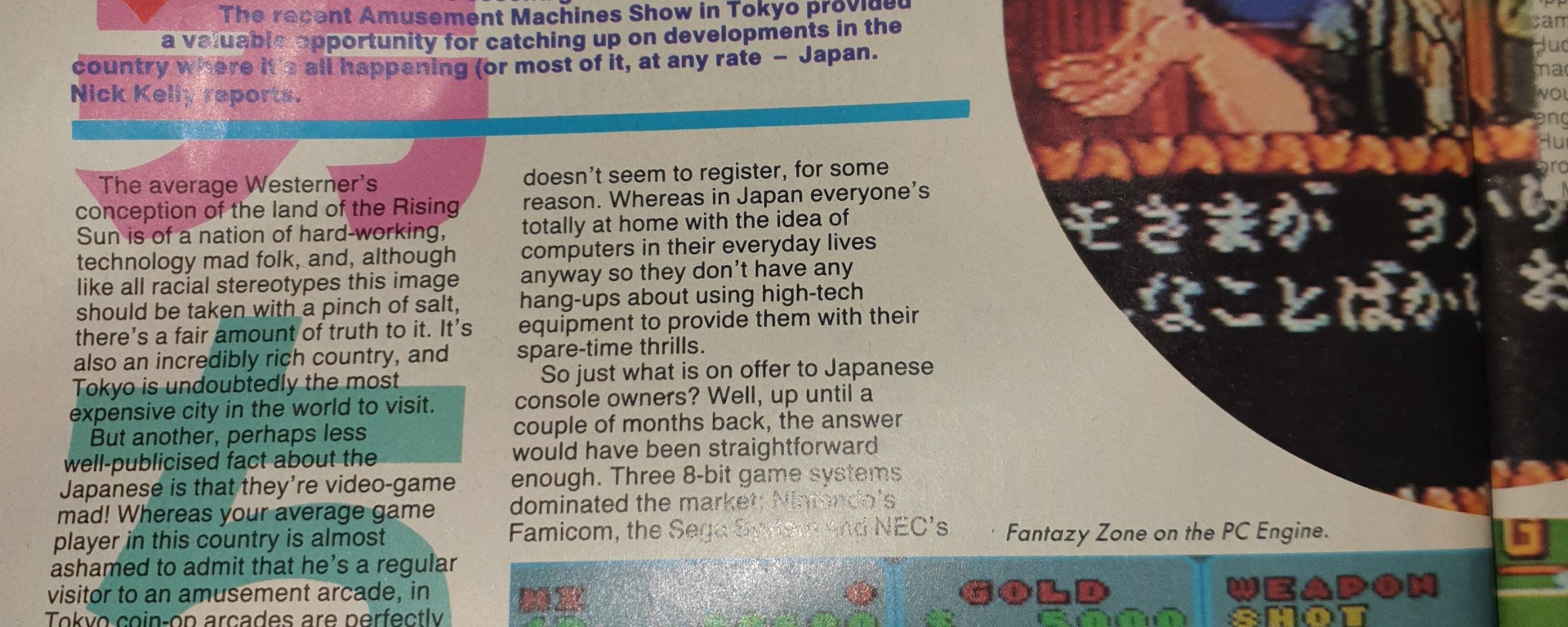
Next up in the Pages from the Past series, we have an article shedding light on the console scene of Japan in late 1988 from a British perspective – and what plans Japanese console manufacturers have to widen their market share there.
Britain: The land of microcomputers and tape-loading! Home of Monty Mole, Dizzy, and Shadow of the Beast – and not a lot of console gaming. The NES, roaring in the US, was a rare beast in the UK. The Master System had a greater presence but by 1989, there were still only 700,000 of them spread out across the whole of Western Europe. The PC Engine is nowhere to be seen. But microcomputers? Millions of the things.
Perhaps this is why there was an allure to consoles such as the nascent Mega Drive and especially the PC Engine. To my young eyes, Japan was an almost mythical techno-paradise. The graphics of the games I’d see magazine writers who imported PC Engines gush about were way, way ahead of what I saw on my parents’ Commodore 64 and my own now-ancient Atari 2600. I would marvel at the screenshots and the fuzzy photographs of the consoles themselves, dreaming of one day owning one.
The article I’ve transcribed below is, according to Julian ‘Jaz’ Rignall, one of the earliest ‘reports from Japan’ that Computer & Video Games ever did. Jaz himself appears in this issue, having joined the CVG team in 1988. It’s a wonderful timepiece that I felt would be an excellent one to present in a more easily readable format.
For this one I did make some grammatical corrections, to make it easier for screen readers to parse the text.
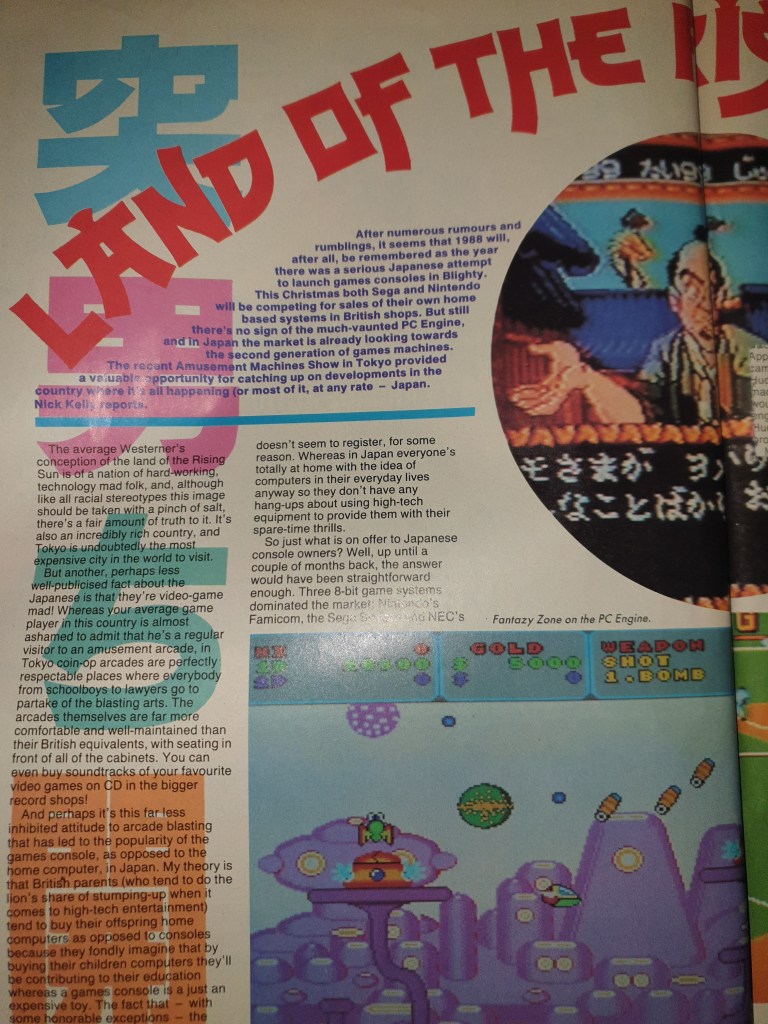
After numerous rumours and rumblings, it seems that 1988 will, after all, be remembered as the year there was a serious Japanese attempt to launch games consoles in Blighty. This Christmas both Sega and Nintendo will be competing for sales of their own home-based systems in British shops. But still, there’s no sign of the much-vaunted PC Engine, and in Japan, the market is already looking towards the second generation of games machines. The recent Amusement Machines Show in Tokyo provided a valuable opportunity for catching up on developments in the country where it’s all happening, or most of it, at any rate – Japan.
Nick Kelly reports.
The average Westerner’s conception of the land of the Rising Sun is of a nation of hard-working, technology-mad folk, and, although like all racial stereotypes this image should be taken with a pinch of salt, there’s a fair amount of truth to it. It’s also an incredibly rich country, and Tokyo is undoubtedly the most expensive city in the world to visit.
But another, perhaps less well-publicised fact about the Japanese is that they’re video-game mad! Whereas your average game player in this country is almost ashamed to admit that he’s a regular visitor to an amusement arcade, in Tokyo coin-op arcades are perfectly respectable places where everybody from schoolboys to lawyers go to partake of the blasting arts. The arcades themselves are far more comfortable and well-maintained than their British equivalents, with seating in front of all of the cabinets. You can even buy soundtracks of your favourite video games on CD in the bigger record shops!
And perhaps it’s this far less inhibited attitude to arcade blasting that has led to the popularity of the games console, as opposed to the home computer, in Japan. My theory is that British parents (who tend to do the lion’s share of stumping-up when it comes to high-tech entertainment) tend to buy their offspring home computers as opposed to consoles because they fondly imagine that by buying their children computers they’ll be contributing to their education whereas a games console is a just an expensive toy. The fact that – with some honourable exceptions – the home computers they buy are exclusively used for playing games doesn’t seem to register, for some reason. Whereas in Japan everyone’s totally at home with the idea of computers in their everyday lives anyway so they don’t have any hang-ups about using high-tech equipment to provide them with their spare-time thrills.
So just what is on offer to Japanese console owners? Well, up until a couple of months back, the answer would have been straightforward enough. Three 8-bit game systems dominated the market; Nintendo’s Famicom, the Sega System and NEC’s PC Engine.
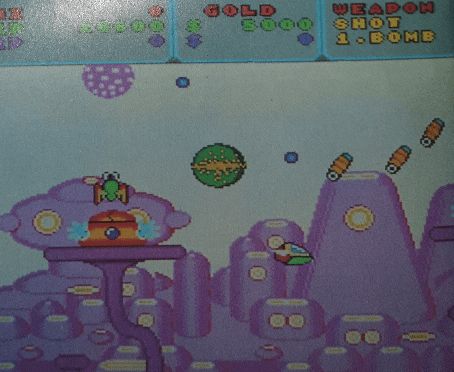
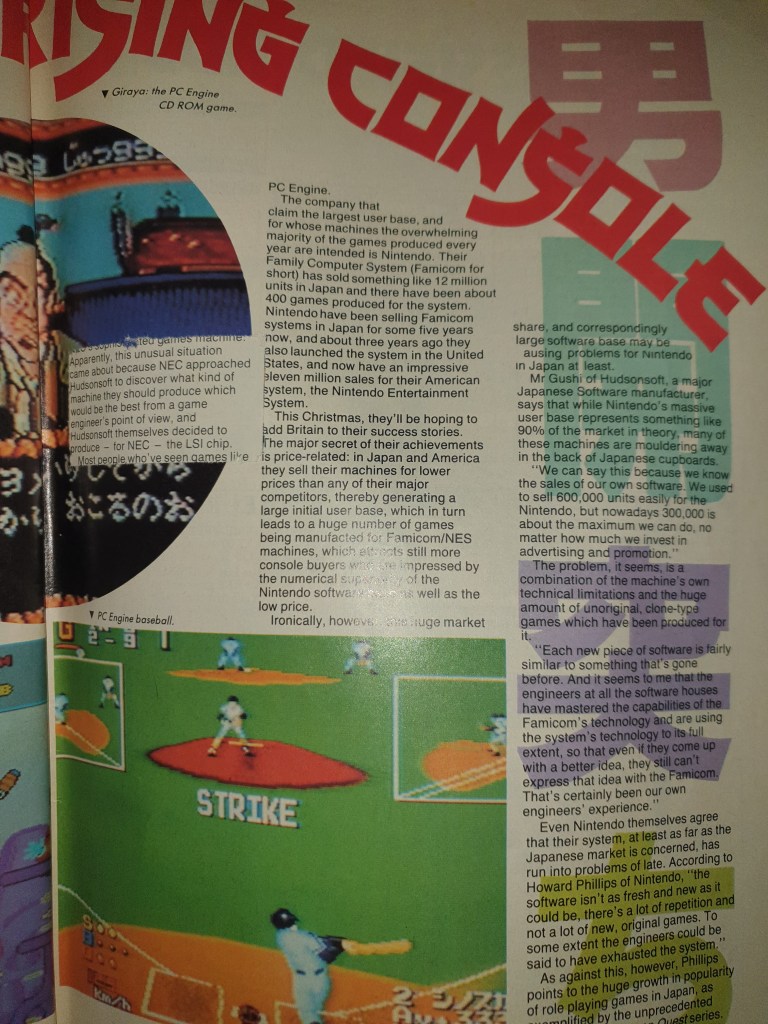
The company that claims the largest user base, and for whose machines the overwhelming majority of the games produced every year are intended is Nintendo. Their Family Computer System (Famicom for short) has sold something like 12 million units in Japan and there have been about 400 games produced for the system. Nintendo have been selling Famicom systems in Japan for some five years now, and about three years ago they also launched the system in the United States, and now have an impressive eleven million sales for their American system, the Nintendo Entertainment System.
This Christmas, they’ll be hoping to add Britain to their success stories. The major secret of their achievements is price-related: in Japan and America, they sell their machines for lower prices than any of their major competitors, thereby generating a large initial user base, which in turn leads to a huge number of games being manufactured for Famicom/NES machines, which attracts still more console buyers who are impressed by the numerical superiority of the Nintendo software base as well as the low price.
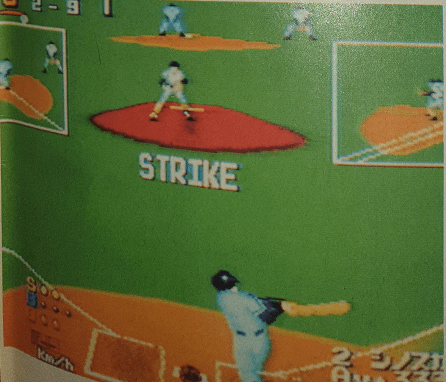
Ironically, however, this huge market share and correspondingly large software base may be
causing problems for Nintendo in Japan at least. Mr Gushi of Hudsonsoft, a major Japanese Software manufacturer, says that while Nintendo’s massive user base represents something like 90% of the market in theory, many of these machines are mouldering away in the back of Japanese cupboards. “We can say this because we know the sales of our own software. We used to sell 600,000 units easily for the Nintendo, but nowadays 300,000 is about the maximum we can do, no matter how much we invest in advertising and promotion.”
The problem, it seems, is a combination of the machine’s own technical limitations and the huge amount of unoriginal, clone-type games which have been produced for it. “Each new piece of software is fairly similar to something that’s gone before. And it seems to me that the engineers at all the software houses have mastered the capabilities of the Famicom’s technology and are using the system’s technology to its full extent so that even if they come up with a better idea, they still can’t express that idea with the Famicom. That’s certainly been our own engineers’ experience.”
Even Nintendo themselves agree that their system, at least as far as the Japanese market is concerned, has run into problems of late. According to Howard Phillips of Nintendo, “The software isn’t as fresh and new as it could be, there’s a lot of repetition and not a lot of new, original games. To some extent, the engineers could be said to have exhausted the system.”
As against this, however, Phillips points to the huge growth in popularity of role-playing games in Japan, as exemplified by the unprecedented success of the Dragon Quest series. This role-playing monster, now in its third incarnation sold a whopping 3 million copies.
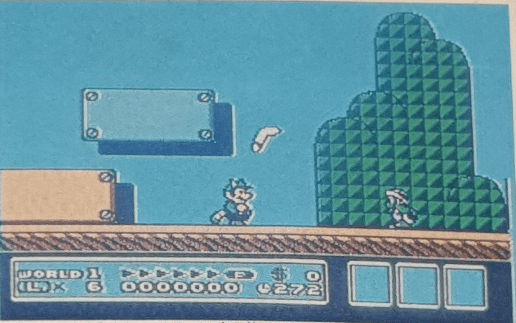
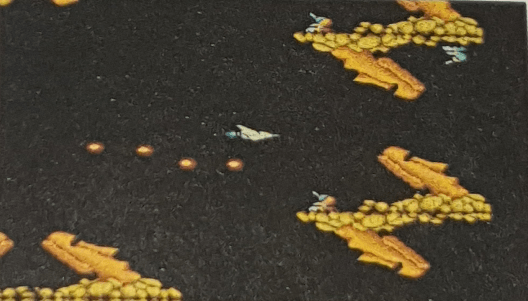

But, as Hudsonsoft’s Mr Gushi points out, “this is unusual, it’s a phenomenon”. He reckons that in terms of regular users, Nintendo’s market share may have fallen by as much as half.
So what does the Hudsonsoft spokesman think is taking up the slack? The answer, according to Gushi, is the PC Engine. Then again, he would do – one little-known fact about Hudsonsoft is that as well as writing software for a range of machines, their software engineers were actually responsible for developing the LSI chip which powers NEC’s sophisticated games machine. Apparently, this unusual situation came about because NEC approached Hudsonsoft to discover what kind of machine they should produce which would be the best from a game engineer’s point of view, and Hudsonsoft themselves decided to produce – for NEC – the LSI chip.
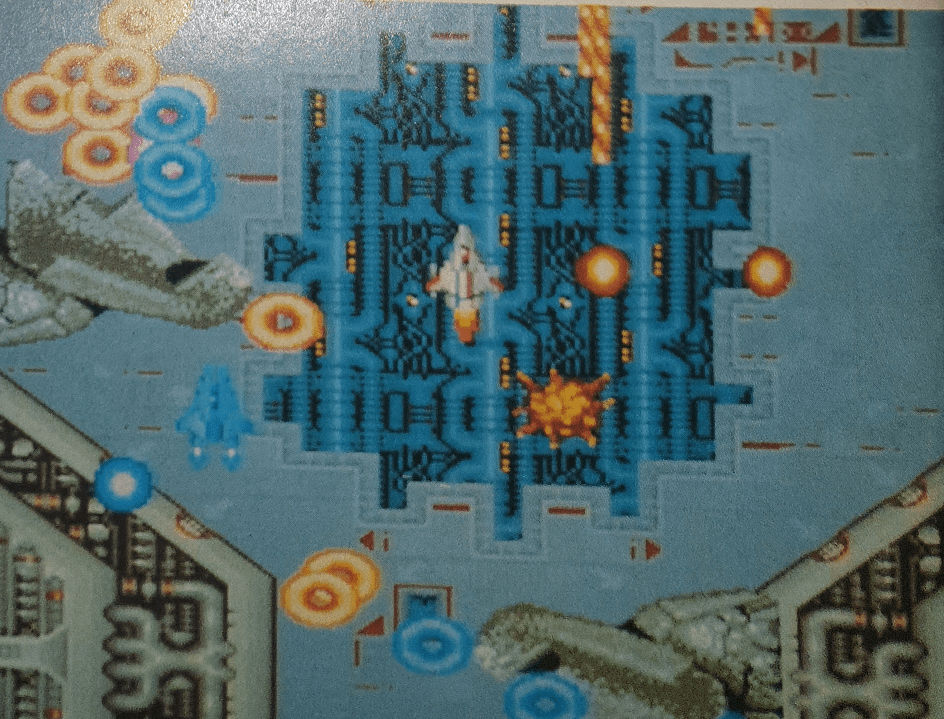
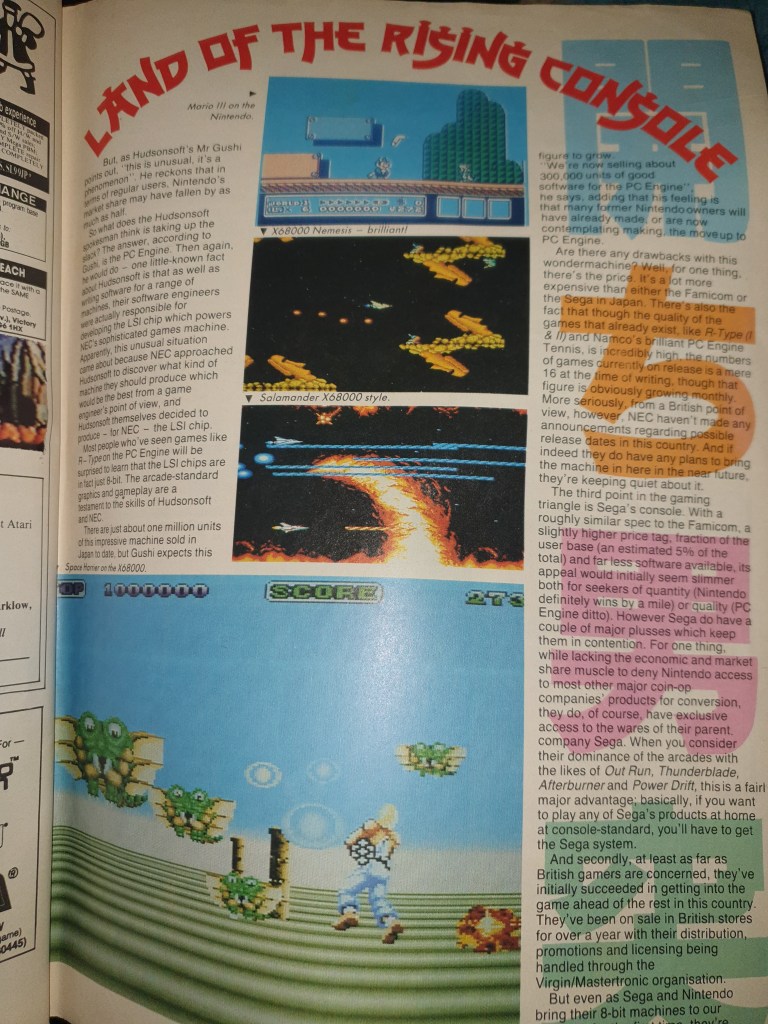
Most people who’ve seen games like R-Type on the PC Engine will be surprised to learn that the LSI chips are in fact just 8-bit. The arcade-standard graphics and gameplay are a testament to the skills of Hudsonsoft and NEC. There are just about one million units of this impressive machine sold in Japan to date, but Gushi expects this figure to grow.
“We’re now selling about 300,000 units of good software for the PC Engine”. he says, adding that his feeling is that many former Nintendo owners will have already made, or are now contemplating making, the move up to PC Engine.
Are there any drawbacks with this wondermachine? Well, for one thing, there’s the price. It’s a lot more expensive than either the Famicom or the Sega in Japan. There’s also the fact that though the quality of the games that already exist, like R-Type (I & II) and Namco’s brilliant PC Engine Tennis, is incredibly high, the number of games currently on release is a mere 16 at the time of writing, though that figure is obviously growing monthly. More seriously, from a British point of view, however, NEC haven’t made any announcements regarding possible release dates in this country. And if indeed they do have any plans to bring the machine in here in the near future, they’re keeping quiet about it.
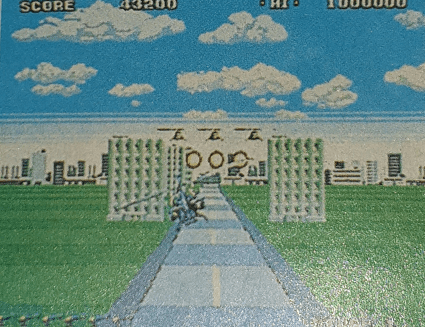
The third point in the gaming triangle is Sega’s console. With a roughly similar spec to the Famicom, a slightly higher price tag, fraction of the user base (an estimated 5% of the total) and far less software available, its appeal would initially seem slimmer both for seekers of quantity (Nintendo definitely wins by a mile) or quality (PC Engine ditto). However, Sega do have a couple of major plusses which keep them in contention. For one thing. while lacking the economic and market share muscle to deny Nintendo access to most other major coin-op companies’ products for conversion, they do, of course, have exclusive access to the wares of their parent. company Sega. When you consider their dominance of the arcades with the likes of Out Run, Thunderblade, Afterburner and Power Drift, this is a fairly major advantage; basically, if you want to play any of Sega’s products at home at console-standard, you’ll have to get the Sega system.
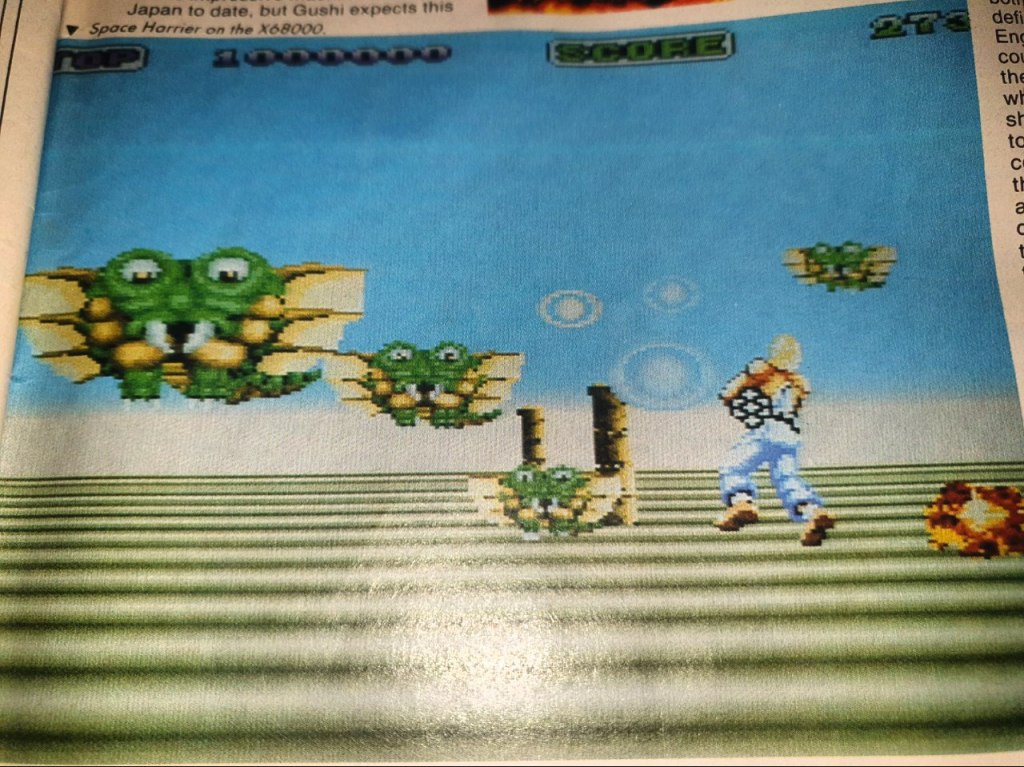
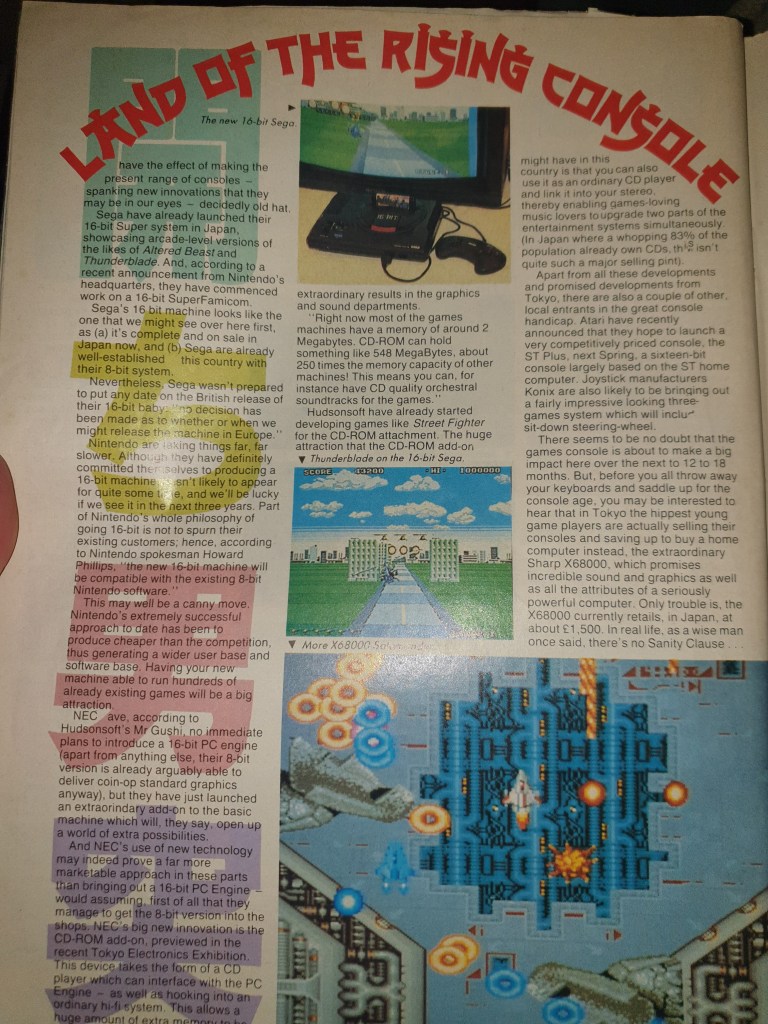
And secondly, at least as far as British gamers are concerned, they’ve initially succeeded in getting into the game ahead of the rest in this country. They’ve been on sale in British stores for over a year with their distribution. promotions and licensing being handled through the Virgin/Mastertronic organisation. But even as Sega and Nintendo bring their 8-bit machines to our attention for the first time, they’re already beavering away at 16-bit super machines which will almost certainly have the effect of making the present range of consoles – spanking new innovations that they may be in our eyes – decidedly old hat. Sega have already launched their 16-bit Super system in Japan, showcasing arcade-level versions of the likes of Altered Beast and Thunderblade. And, according to a recent announcement from Nintendo’s headquarters, they have commenced work on a 16-bit Super Famicom.
Sega’s 16 bit machine looks like the one that we might see over here first, as (a) it’s complete and on sale in Japan now, and (b) Sega are already well-established this country with their 8-bit system. Nevertheless, Sega wasn’t prepared to put any date on the British release of their 16-bit baby: “No decision has been made as to whether or when we might release the machine in Europe.”
Nintendo are taking things far, far slower. Although they have definitely committed themselves to producing a 16-bit machine, it isn’t likely to appear for quite some time, and we’ll be lucky if we see it in the next three years. Part of Nintendo’s whole philosophy of going 16-bit is not to spurn their existing customers; hence, according to Nintendo spokesman Howard Phillips, “the new 16-bit machine will be compatible with the existing 8-bit Nintendo software.”
This may well be a canny move. Nintendo’s extremely successful approach to date has been to
produce cheaper than the competition, thus generating a wider user base and software base. Having your new machine able to run hundreds of already existing games will be a big attraction.
NEC have, according to Hudsonsoft’s Mr Gushi, no immediate plans to introduce a 16-bit PC engine (apart from anything else, their 8-bit version is already arguably able to deliver coin-op standard graphics anyway), but they have just launched an extraordinary add-on to the basic machine which will, they say, open up a world of extra possibilities.
And NEC’s use of new technology may indeed prove a far more marketable approach in these parts than bringing out a 16-bit PC Engine would assuming, first of all, that they manage to get the 8-bit version into the shops. NEC’s big new innovation is the CD-ROM add-on, previewed in the recent Tokyo Electronics Exhibition. This device takes the form of a CD player which can interface with the PC Engine – as well as hooking into an ordinary hi-fi system. This allows a huge amount of extra memory to be accessed by the machine, with extraordinary results in the graphics and sound departments.
“Right now most of the games machines have a memory of around 2 Megabytes. CD-ROM can hold something like 548 MegaBytes, about 250 times the memory capacity of other machines! This means you can, for instance, have CD-quality orchestral soundtracks for the games.”

Hudsonsoft have already started developing games like Street Fighter for the CD-ROM attachment. The huge attraction that the CD-ROM add-on might have in this
country is that you can also use it as an ordinary CD player and link it into your stereo, thereby enabling games-loving music lovers to upgrade two parts of the entertainment systems simultaneously. (In Japan where a whopping 83% of the population already own CDs, this isn’t quite such a major selling point).
Apart from all these developments and promised developments from Tokyo, there are also a couple of other, local entrants in the great console handicap. Atari have recently announced that they hope to launch a very competitively priced console, the ST Plus, next Spring, a sixteen-bit console largely based on the ST home computer. Joystick manufacturer Konix are also likely to be bringing out a fairly impressive-looking three-game system which will include a sit-down steering wheel.
There seems to be no doubt that the games console is about to make a big impact here over the next 12 to 18 months. But, before you all throw away your keyboards and saddle up for the console age, you may be interested to hear that in Tokyo the hippest young game players are actually selling their consoles and saving up to buy a home computer instead, the extraordinary Sharp X68000, which promises incredible sound and graphics as well as all the attributes of a seriously powerful computer. Only trouble is, the X68000 currently retails, in Japan, at about £1,500. In real life, as a wise man once said, there’s no Sanity Clause…
As I did with the previous Pages from the Past, I’ll share photos of the feature taken from my copy of this issue.
 Scanline Artifacts
Interesting that “bits” as a marketing device appears to have started in Japan. Did they know what it meant over there from the home computer scene?
LikeLike