


Ah, Demolition Man! One of my favourite movies of the ’90s. It’s a perfect blend of blockbuster action, comedy, and just enough social commentary to give you something to chew on alongside your popcorn.
As with other Hollywood blockbusters of the era, Demolition Man was also rich fodder for video game adaptations. Three of them (Super Nintendo, Mega Drive, and Mega-CD) follow the standard template formula for 8 and 16-bit movie licence games: action-platformer with a smidgen of variation, in this case by throwing in a couple of top-down Chaos Engine-alike stages.

They’re competently done, which is about the most you could generally hope for from movie licence games back then. But! There is also another adaptation out there with more ambition; the kind of ambition born of a CD drive and 32-bit processing power. No, no, sit down, Mega-CD version! You’re just the Mega Drive version with better music and some grainy video clips thrown in! And stand up and take a bow, the 3DO version! Just a small one, mind, but a deserved one all the same.
The Star of the Show
Of the four console game adaptations, it is the 3DO version that is inarguably the star of the show. Developed and published by Virgin Interactive Entertainment and released in 1994, their Demolition Man game both draws from past movie licence games and looks ahead to the near future with the kind we’d see on the PlayStation and Saturn.
Okay, for those who haven’t seen Demolition Man, I’ll give you a quick run down as we go along. The year is 1996 (a few years on from the release of the movie), and things are not looking great for the city of Los Angeles, as indicated by the iconic opening where the Hollywood sign is ablaze.

Enter tough-guy cop John Spartan (Sylvester Stallone), who has picked up the nickname of the ‘Demolition Man’ for his habit of causing immense amounts of collateral damage in the course of perp-busting. The movie opens on his latest bust: an unauthorised raid to bring in psychopathic killer Simon Phoenix (Wesley Snipes), holed up with his gang and their hostages in an abandoned warehouse.

These stills are from one of the highlights of the 3DO game: clips from the movie of pretty good quality in full-screen with much less desaturation when compared to those of the Mega CD game. We get what amounts to a Cliffsnotes version of the opening. But then, something else happens:

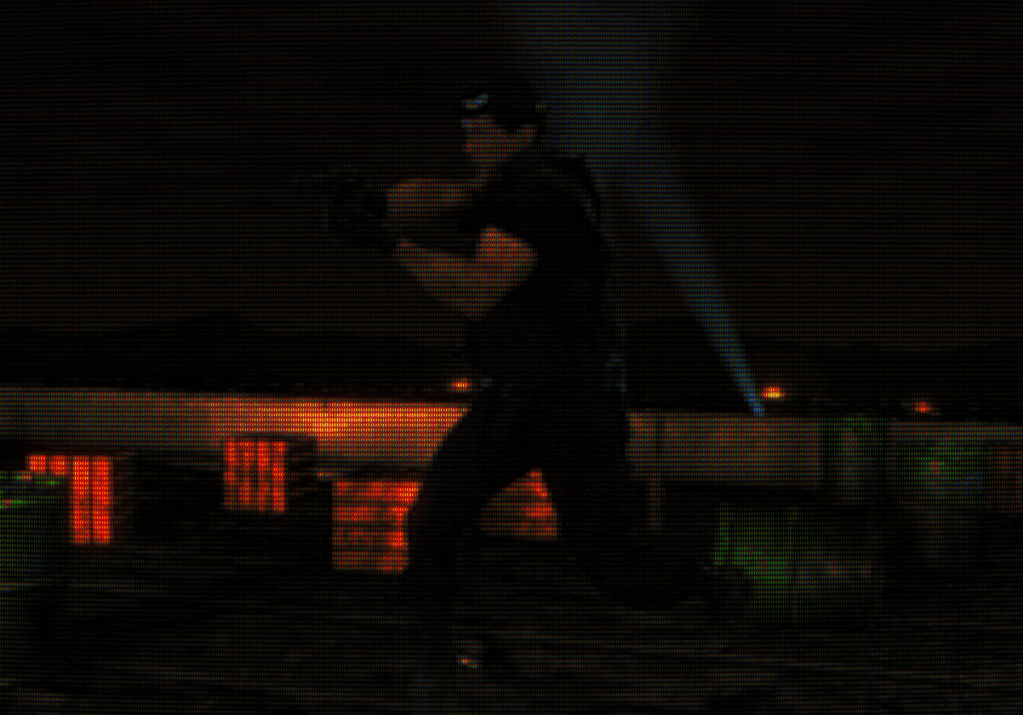
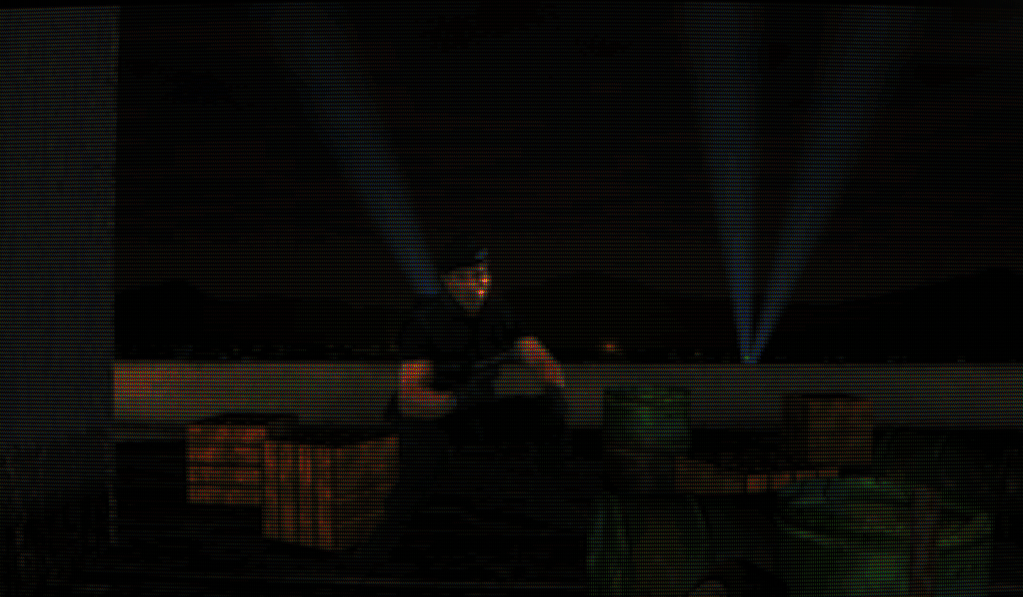

We get new live-action chroma key scenes that do not feature in the movie!
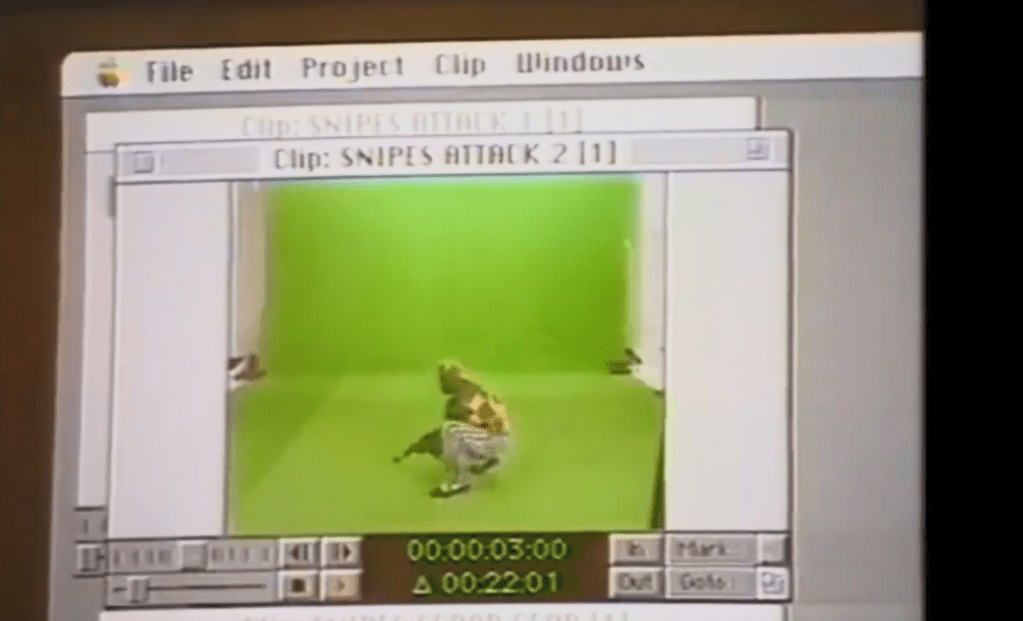
These were a pretty big thing at the time as they were filmed alongside the movie itself. As soon as someone yelled ‘Cut!’ Sly and co then got busy in front of a green screen and filmed bespoke cutscenes for the game, mostly ones that link one scene to the other. So, in this opening level, we get Sly posing with his pistol and acting all sneaky-like.
Then the game action proper kicks in: a fixed-perspective gallery/light gun shooter with a mix of pre-rendered graphics and digitised actors that were also chroma keyed.

I’m fond of light gun shooters and so, I was quite pleased when I first played this game a few years back during my initial digs into the 3DO library. And unlike some of the games that used digitised actor sprites (especially those on 16-bit hardware), this one doesn’t look ugly. Music taken from the movie (composed by Elliot Goldenthal) accompanies the pew-pew action, adding that extra layer of authenticity.
It’s a competent light gun shooter with support for both joypad and light gun. I’ve only played it with the joypad, but it plays well with the ability to speed the crosshair across the screen at a button push, and open fire with three types of bullets. You get a neat little animated hand that swivels about in time with the crosshair position, which helps immerse you in the scene.
Put ’em up, Phoenix!
After a few levels of static gallery shooting linked by the live-action cutscenes mentioned previously, you’re greeted by the next game genre from the grab-bag of those that the game plucks from: fighting game.

The game switches to a side-on perspective, with John and Simon duking it out in a blazing building. Alas, here’s where things start to go a bit wrong: it’s not an especially good fighting game section. The fighting controls are stiff and there’s often a noticeable delay (which I confirmed in other reviews exists too when using actual hardware) in you pushing a button and a fighting move actually going through.

As we can see from the manual, there’s a decent amount of complexity to the fighting system. Unfortunately, the timing can also be a bit finicky and there’s not a lot of fluid counter-play. It’s not awful, and the production values continue to be high, but it’s not especially good, either.
Welcome to San Angeles, circa 2032.
As the warehouse goes up in an explosion befitting his nickname, John is framed for the involuntary manslaughter of the hostages he had no idea were there (thermal scans did not reveal their presence). Both he and Simon are sentenced to a new form of imprisonment: cryogenic freezing and rehabilitation.

Alas, it all goes a bit wrong after Phoenix is thawed out for a parole hearing 36 years later and he manages to break out of the cryo-prison due to some conspiratorial shenanigans. Thus, he’s free to menace the crap-saccharine future metropolis of ‘San Angeles’, where strict moral conditioning and omni-present surveillance has left the police officers of 2032 completely unprepared for an actual murderous criminal of the kind they haven’t seen in decades. Faced with a reign of terror in the making, Spartan is brought out of the freezer early and reluctantly reinstated as a police officer to help the SAPD bring him to justice.


This is all established with a mix of movie clips, the new chroma key footage, and pre-rendered sequences. And I have to say, it all works superbly well. Had I been a 3DO owner (or if it had been ported to PlayStation), I would have been chuffed to bits at Demolition Man’s presentation. It’s one of the most ‘multimedia’ feeling games on there that’s not a straight-up FMV adventure game.
In the Museum of Violence, where the pacifistic citizens of San Angeles can gawk at the ‘primitive’ weapons of their savage past, you encounter Phoenix helping himself to an arsenal – enough to equip the small army of fellow unfrozen ‘cryocons’ And it’s here you’ll once again go through a shooting gallery section and another punch-up with the psychopath.
Now, I was getting pretty comfortable with the game, that this would be the formula for the rest. But oh ho, the game has another surprise up its sleeve.
You’re DOOMed, Phoenix!

Colour me surprised when, at the start of the third stage, the game shifts to a genuine FPS. Armed with a scanner in one hand and pistol in the other, you must navigate Spartan through maze-like sewer tunnels, taking out cryocons along the way.
As much as a pleasant surprise this was, here’s the rub: as with the fighting game sections, it’s not a particular good example of its genre. There’s little subtlety to the gameplay, even less so than Wolfenstein 3D, and no additional weapons or health packs to pick up. The enemies will just run at you en masse, blazing away. You do have regenerating health, but it can be frustrating to make your way through these stages as the frame rate is quite choppy and it feels sluggish. It does have a cracking soundtrack though and is plenty atmospheric.
I’ll give them some credit for just existing at all and trying to work with what was shown in the movie, but as these FPS levels go on to comprise more than half the content in the game, they’re actually the main meat. So, some more variety would have been welcome.
Hit the Road, chum!
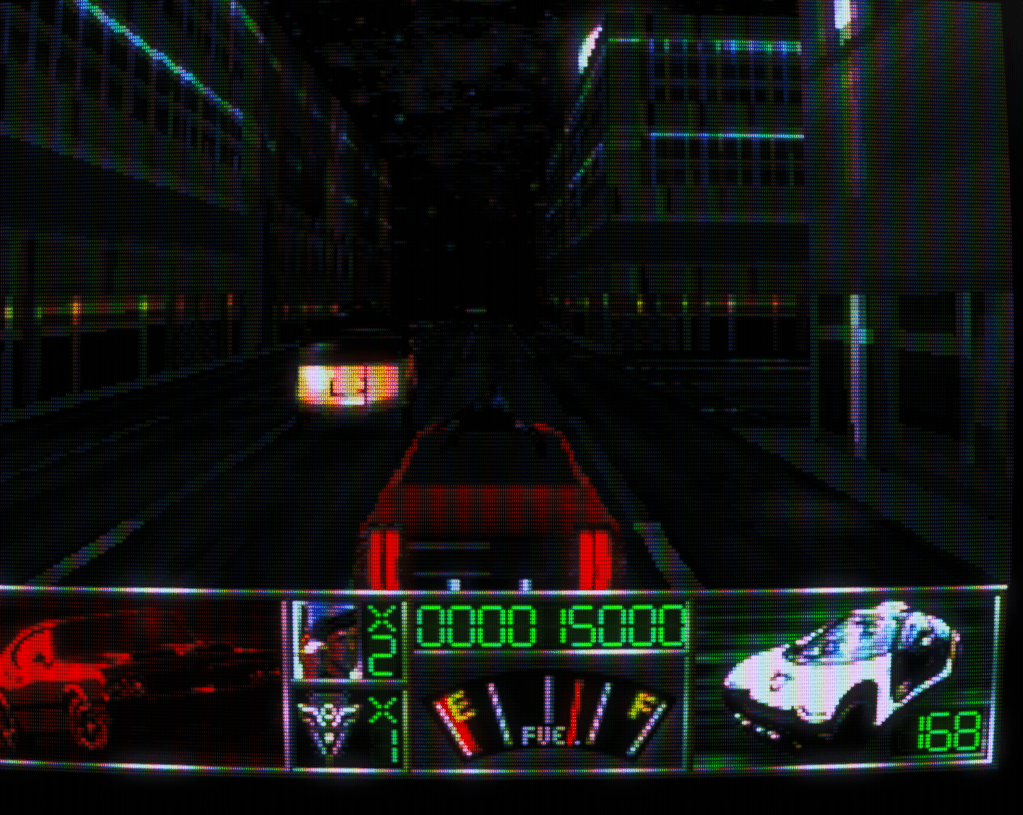
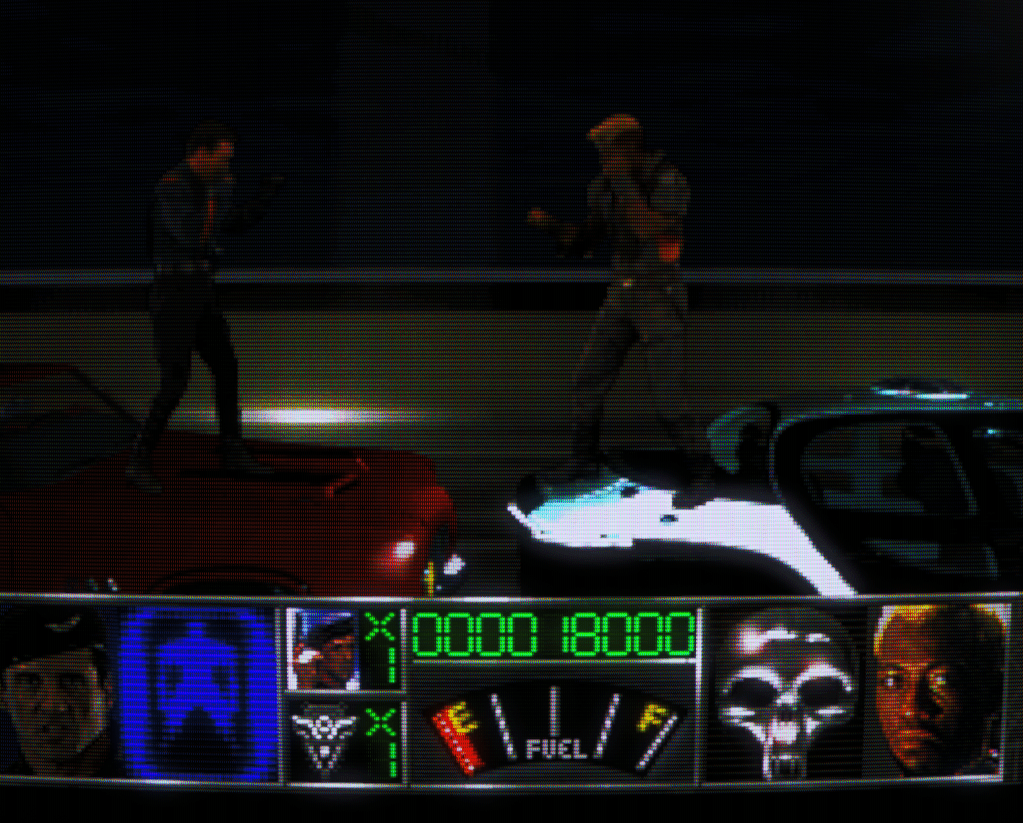
Well, colour me surprised yet again: a car chase section, all done in a 32-bit Road Rash-esque style with polygonal texture-mapped buildings at the sides and boxy vehicles.
Sadly, this section sucks! You quickly learn that you don’t actually need to do anything to make your way smoothly through the city traffic and catch up with Phoenix’s stolen police car; you’ll cause yourself more trouble trying to weave around it! It’s a shame, because the devs put genuine effort into the graphics and presentation, but once again, let the gameplay slip by them. This is easily the worst section of the game, followed up by another fighting section.
After that, the game has no more genre surprises for you, serving you up a farewell cocktail of movie clips, FPS, gallery shooter, and fighting game sections for the showdown in the cryogenic prison.
But! Demolition Man does have one more wrinkle for you: secret levels unlocked by a cheat code! Punch in the right one and you’ll gain access to a slew of bonus FPS levels, all themed after the Virgin offices!

In Conclusion
I said at the start that 3DO Demolition Man harkens back to the past, and it does in being an Ocean Software-style movie tie-in with a different genre of game per stage. Unfortunately, it also inherits the jack-of-all-trades-and-master-of-none nature of some of Ocean’s movie licence games.
In spite of that, I can’t help but admire Virgin Interactive for what they tried to do with Demolition Man on 3DO. They chose not to fall back on the time-worn action-platformer formula, and in doing so, they looked ahead to future movie adaptations such as Die Hard Trilogy and Alien Trilogy. They used the CD medium well, striving for more varied and meaningful gameplay than some of the FMV-heavy action games that had come before it.
So, despite its flaws, Demolition Man is still one of my favourite 3DO games, and I would absolutely own it if they had ported it to PlayStation (which was on the cards at one point, according to Australia’s Hyper magazine). I recommend giving it a blast, and putting in a stage-select cheat if you do struggle with any particular level. There’s a feeling of passion and effort behind all they did with it and as ever, that goes a long way with me, and it deserves to be experienced firsthand.
Oh! And check out this clip from UK 90s tech news and video game review TV show Bad Influence. Early in its run, they featured a making of segment. It’s a neat behind-the-scenes look into its development and how the chroma key sequences were filmed and edited.
If you’ve enjoyed this article and would like to support me in writing more long-form features, Pages of the Past, and Adventure Logs, then you can do so on my Patreon, via Kofi, or by picking up copies of my digital zine, Between the Scanlines.
 Scanline Artifacts