


As a child of the 80s and early 90s enamoured with space, the ‘Space Shuttle’ (officially termed the Space Transportation System) was one of the more visible developments in humanity taking our first steps into the great beyond. I was too young at the time to grasp the tragedy of the Challenger disaster and its ramifications, so posters of them from Quest magazine remained on my wall and I eagerly awaited any news broadcast footage of a launch.
I also had a Shuttle video game for my Atari 2600, Activision’s Space Shuttle: A Journey into Space.

This was pretty amazing stuff for the hardware. A valiant attempt to convey simulation feel into a console with a one button joystick and a bank of physical switches (which my hand-me-down wood grain VCS had), Space Shuttle: A Journey into Space further fed my appetite for ‘space games’.
Cut to just five years ago, when I’d really got into the NES library after doing weekly delves on Twitter-as-was for several months. On the hunt for juicy titbits of forgotten games and ‘hidden treasures’, this was when I first stumbled across the star of this new article: Space Shuttle Project.

Space Shuttle Project immediately felt like a spiritual successor to that original Shuttle game, even more so after I learned that Absolute Entertainment was founded by Dan and Garry Kitchen, formerly of Activision. (The Atari 2600 version of Space Shuttle: A Journey into Space was designed by Jessica Stevens, then credited as Steve Kitchen.)
So, with that said, let’s now slip into our pressured white spacesuits and prepare to go on a new Journey into Space.
All Aboard the Columbia!
Your time with Space Shuttle Project is split up, just like the original game was, into a series of smaller phases. After hitting start, you’ll be greeted by a message from the Launch Director and asked to enter your name. We’re also given a faux-digitized photograph of our commander, who has a distinctly William H. Macy vibe to their appearance. I hope, too, that your name is six characters or fewer.
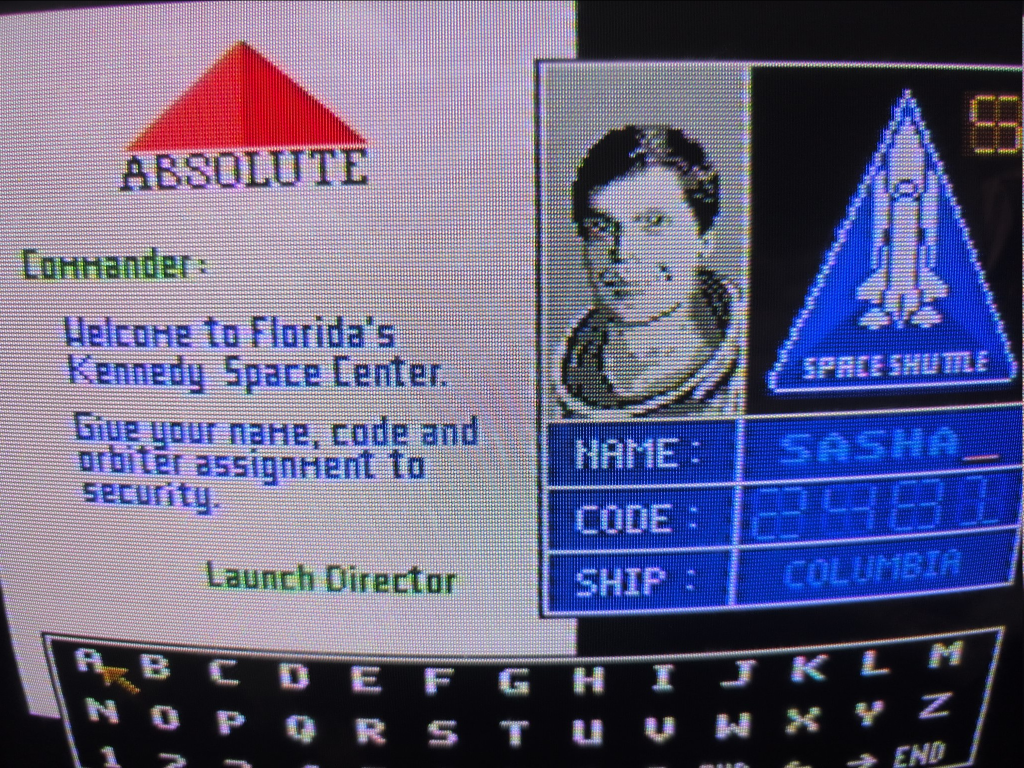
Then the first little gameplay challenge arrives – I hope you’ve read the manual beforehand so you know what to do. You’re required to make a mental note of or write down your four-digit security code and the orbiter to which you’ve been assigned. In this case, Columbia. Then both the code and ship will start cycling through random numbers and letters, and you’ll have to hit a button several times to stop on the correct ones that correspond to the code and ship you were given. It’s a simple little timing puzzle that, at first, I wasn’t sure if was some sort of copy protection. But no, just the first little minigame and also the way to resume progress at a later stage.
With our security clearance approved, it’s now time to begin the process of fuelling and boarding the shuttle.

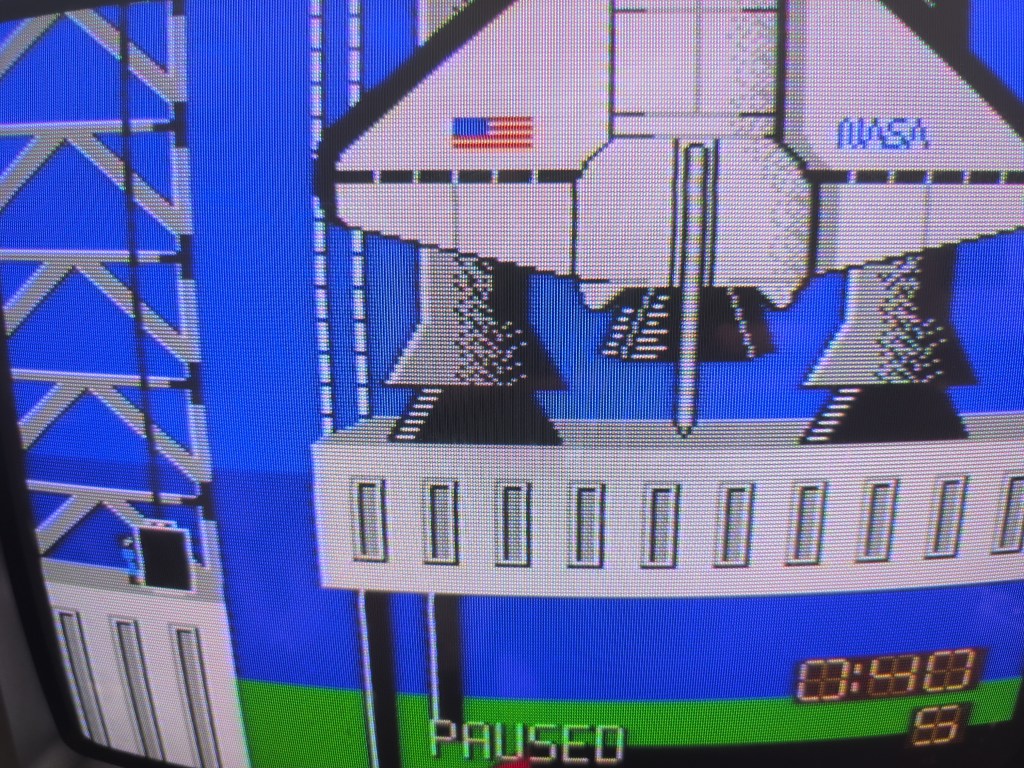
This is done through a minigame where I feel some of Activision’s Ghostbusters and Aliens games lineage comes through. You guide your shuttle crewperson up and down the elevator, activating switches and pumps in the correct sequence and opening the hatch. Then you race down to the bottom to collect the crew and deliver them back up to the hatch, all within the span of a time limit and avoiding gantry hazards along the way that knock you back and steal some precious time from you. It’s simple stuff, but a nice way of imparting some key procedure in a shuttle launch.
3… 2… 1… We Have Takeoff!
Now all aboard and fuelled up, we’re ready for those mighty main boosters to take our space plane into orbit. We’re treated to some impressively clear speech and little cutscenes of the orbiter cockpit, all very exciting and authentic.
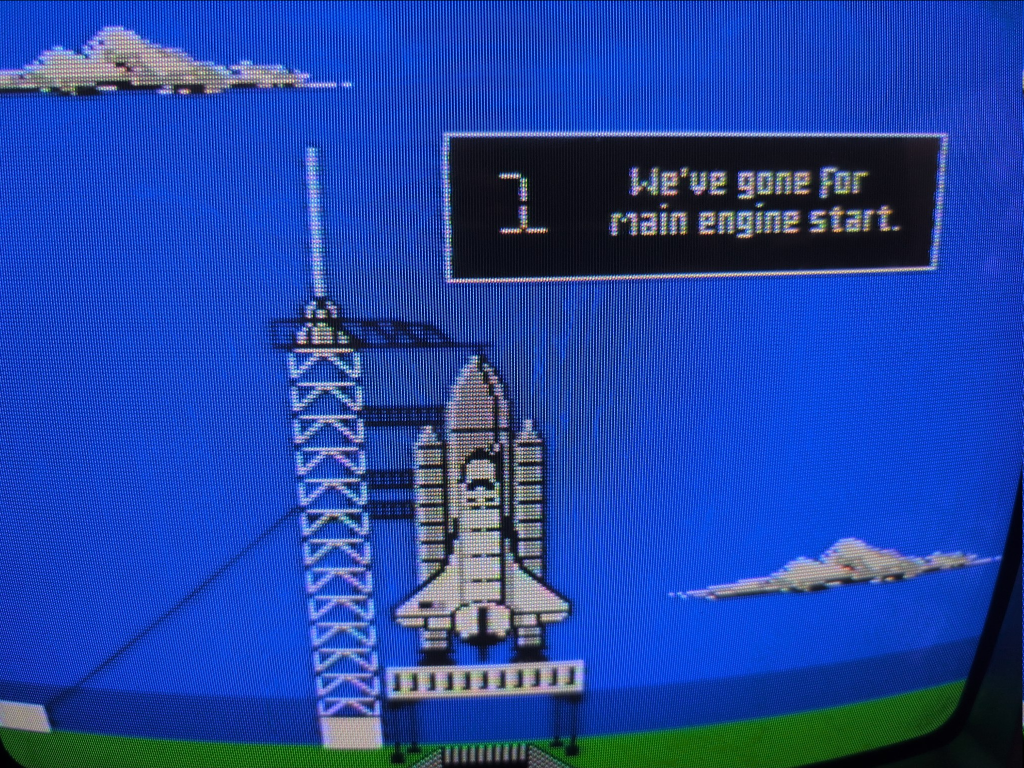

Gameplay now switches to what are effectively quick time events, requiring you to tap a button at the right time as a dial moves forward, and match a triangular indicator as it erratically moves left and right.


This is all detailed in the manual, which at first glance, may look like it’ll be complicated stuff, but it’s not. It’s just hit the button or move the d-pad left and right at the correct time.
Zoinks, We’re Scattering Satellites, Scoob!
Now that we’re in orbit, it’s time to get to work. Phase Three is the main meat of the game, split up into one of five missions. You’ll work through them all sequentially, and is where the longevity of the game is found. You’ll need to go through the launch procedure each time, and are awarded a ‘secret code’ to start from the one you left off on, should you lose all your attempts, or it’s time to turn the NES off. I won’t showcase them all here, only the first couple.
Mission one requires us to place satellites in their correct orbital path.
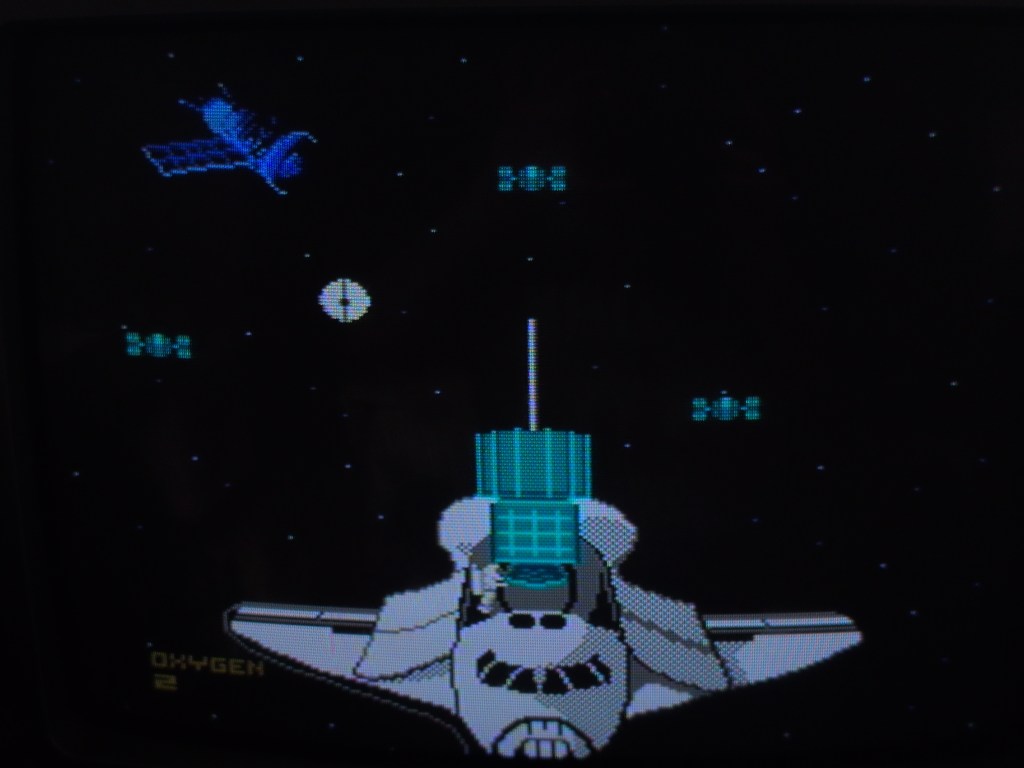
This mission is akin to Frogger with a little of the old microcomputer game Thrust thrown in for good measure, and where the difficulty starts to ramp up. You need to guide the satellite up the screen, avoiding other orbital objects on the way, all while taking into account momentum from your jetpack thrusts. Then you need to leave just enough time for the satellite to deploy and open its solar panels before it gets hit by one of the satellites moving horizontally across the screen. This is tricky and took me four attempts to succeed.
Ramping Up the Difficulty
You’ll need to complete the launch sequence again, but this time around there’s a longer time limit as you’ll need to get not one but two extra crew members aboard: payload and mission specialists. And then there are a couple of extras steps in the flight manoeuvre phase, including a ‘Simon Says’ style challenge. Which I failed, but the game seemingly took pity on me and moved me onto the next.
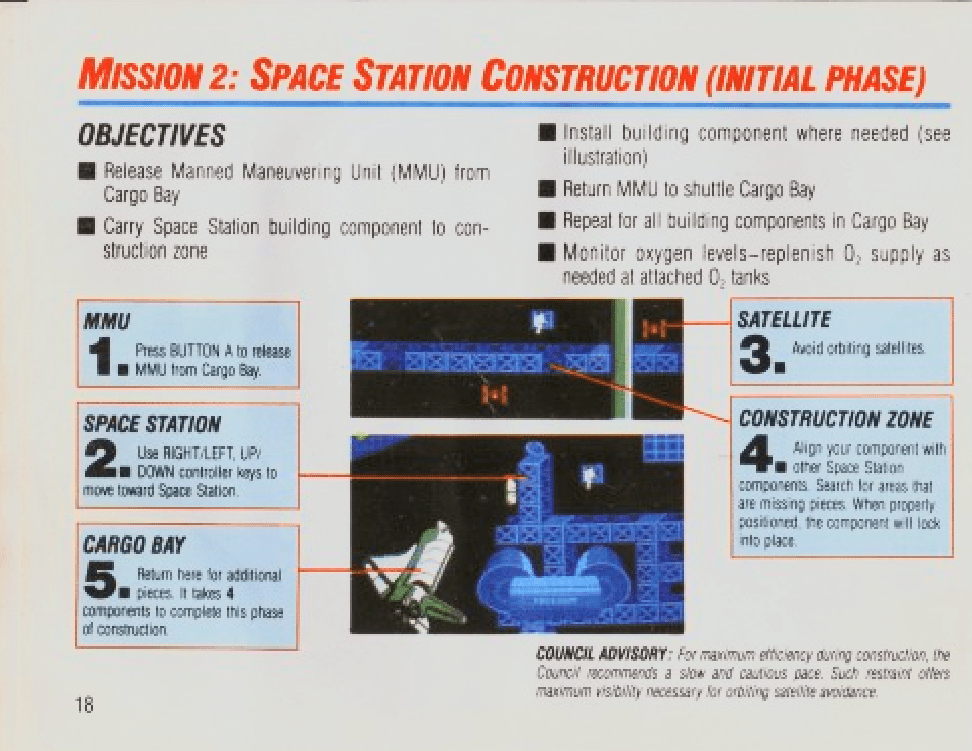
It’s more jetpack shenanigans, this time assisting in the construction of ‘Space Station Freedom’, an ultimately cancelled project to put a permanently-manned NASA-led space station in orbit. The project hadn’t yet been scaled down at the time of Space Shuttle Project‘s release, so it was still very much an envisioned thing for the near future. Ultimately, it would evolve into the International Space Station.
Here in our mission, we must manoeuvre construction parts, cube-shaped frameworks, into gaps in Freedom’s ongoing construction, all while avoiding drifting satellites and being aware of our oxygen supply. Momentum and thrust-management again feature heavily. It’s a case of trial-and-error to see which graphical elements are traversable and which are blockers, which can get a wee bit annoying as it is initially unclear. Then we have another descent, re-entry, and landing sequence, again a little harder than the first.

Mission Complete, Absolute Entertainment.

I really like Space Shuttle Project. It feels like it could come under the edutainment category, as there is just enough real-world shuttle launch/mission procedure complexity to feel that you’re learning. The gameplay is… okay, overall? It does feel a little bit dated for 1991; SSP could easily have been a C64 game from 1987. But it’s clearly a passion project and has plenty of charm to it, something that, as ever, goes a long way with me. And as a space nerd to this day, I still get a kick out of feeling like I’m part of a shuttle crew.
With the Shuttle program long-defunct and replaced by cheaper alternatives, it’s a lovely little timepiece of what was once NASA’s backbone for orbital space exploration and development, and one of the NES’s most interesting ‘hidden gems’.
If you’ve enjoyed this article and would like to support me in writing more long-form features, Pages of the Past, and Adventure Logs, then you can do so on my Patreon, via Kofi, or by picking up copies of my digital zine, Between the Scanlines.
 Scanline Artifacts