


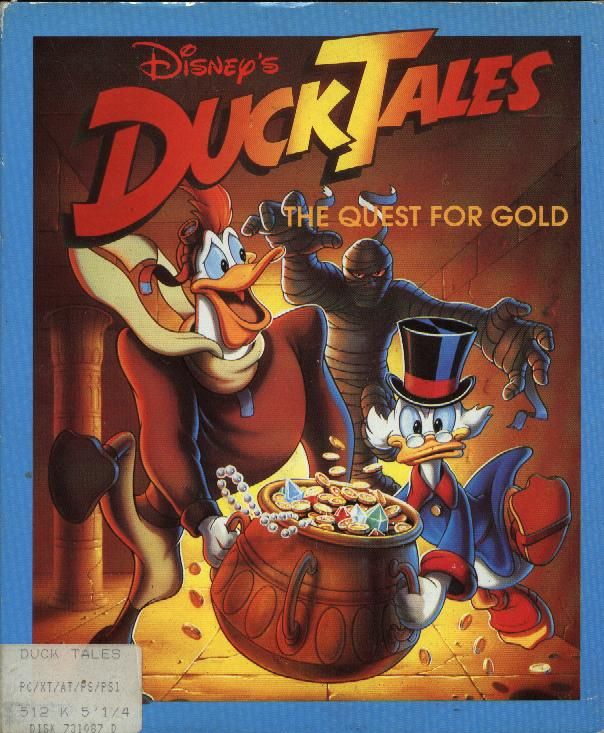
Well, this was a surprise! When I spotted this game (released in 1990) while browsing C64 Dreams’ library of curated games earlier in the week, I anticipated a platformer of the same kind as the NES Duck Tales game. What I didn’t expect was to embark on a race-against-time adventure involving stock trading and manipulation.
Dime Magazine’s Duck of the Year
Scrooge McDuck, the richest duck in the world (but a kind-hearted and generous member of Disney’s extended family of avian cartoon characters) has been challenged by the mean and miserly Flintheart Glamgold, his jealous rival: whoever finds the most money in thirty days will be named, ahem, Dime Magazine’s (be prepared for more like this!) Duck of the Year.

The scene is set through a cutscene featuring some truly gorgeous cartoony graphics. The screenshot above is from the impressive C64 version, but I’ll hand it to the Amiga version’s rich colour palette, adding that extra graphical oomph and very much feeling like a generational leap over its 8-bit home computer kin.

With the challenge set, you pick from one of three difficulty levels: ‘Easy Money’, ‘Standard Wages’, and ‘Hard Earned Cash.’

The gauntlet has been thrown down, with Scrooge accepting the challenge. And given that you begin with zero dollars, I’m guessing the terms of the contest do not include your existing wealth.
Duck Tales: The Quest for Gold plays something like a digital board game. You’ll be able to take a certain number of ‘moves’ within each thirty-day playthrough, with each activity taking a certain number of days.
Here in Scrooge’s plush office, which serves as a hub, you have three choices: Investments, Money Bin, and Control Center. Each will allow you to earn some coin.

How Rich Do You Want to Be?
Let’s take a look at the investments, aka stock market shares. And oh boy, be prepared to groan and shake your head with a smile at some of the referential company names.

Gull Oil? Amquack Railroad? Otherwise known as Gulf Oil and Amtrak, which immediately tasks you with being old enough now to remember some of these companies and references.

Given that a younger audience would most likely be playing this, the manual gives you some tips on what to do in a way that feels like this might be, in some part, a piece of edutainment software.


The way that the stock market in this game works, with share growth and fall depicted for the span of the 30 days on the charts above and each company listed as A, B, C, or D, also makes me feel this is additional copy protection against piracy. These aren’t shown anywhere in the game; you’ll have a pretty hard time succeeding in shares otherwise. There are random events that will affect prices to add elements of replayable randomness, some of which are caused by the machinations of your rival, but broadly speaking, you’ll need to check back in on certain days to buy or sell shares according to the charts.
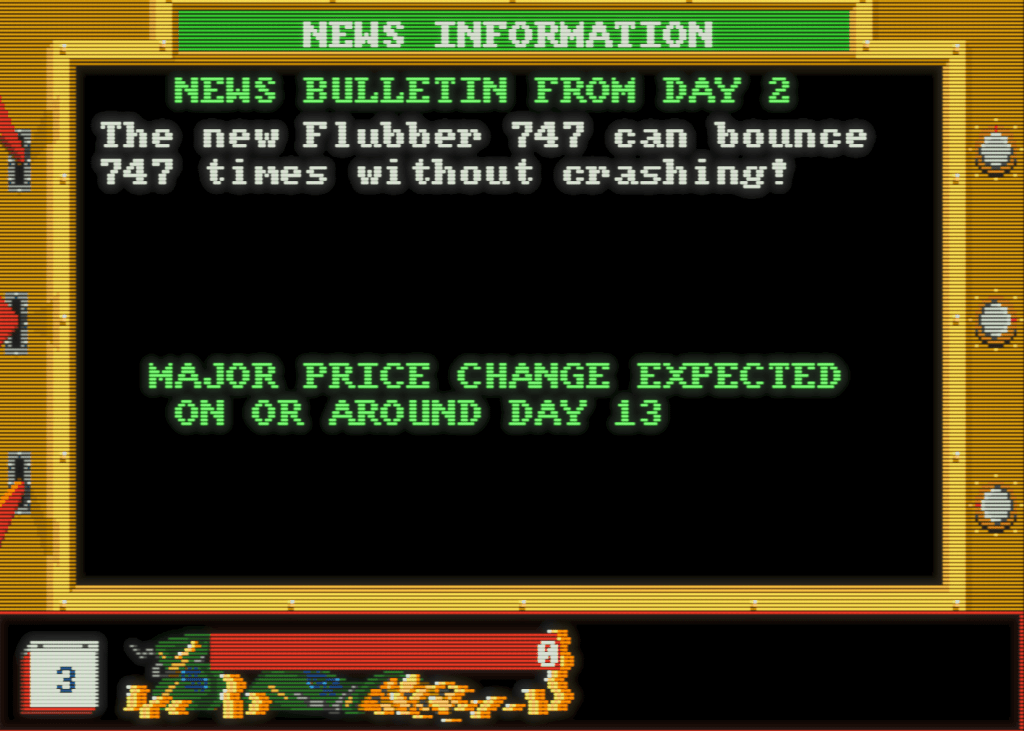
It’s a surprisingly fleshed-out aspect of the game, one wholly unexpected when we first fired it up blind, and adds some neat management aspects and time-pressure to the game, should you choose to engage with it. You don’t have to, as the returns you’ll get aren’t all that key to winning the game, at least on the easiest difficulty. But I enjoyed doing so anyway.
Dive Deep into The Money Bin
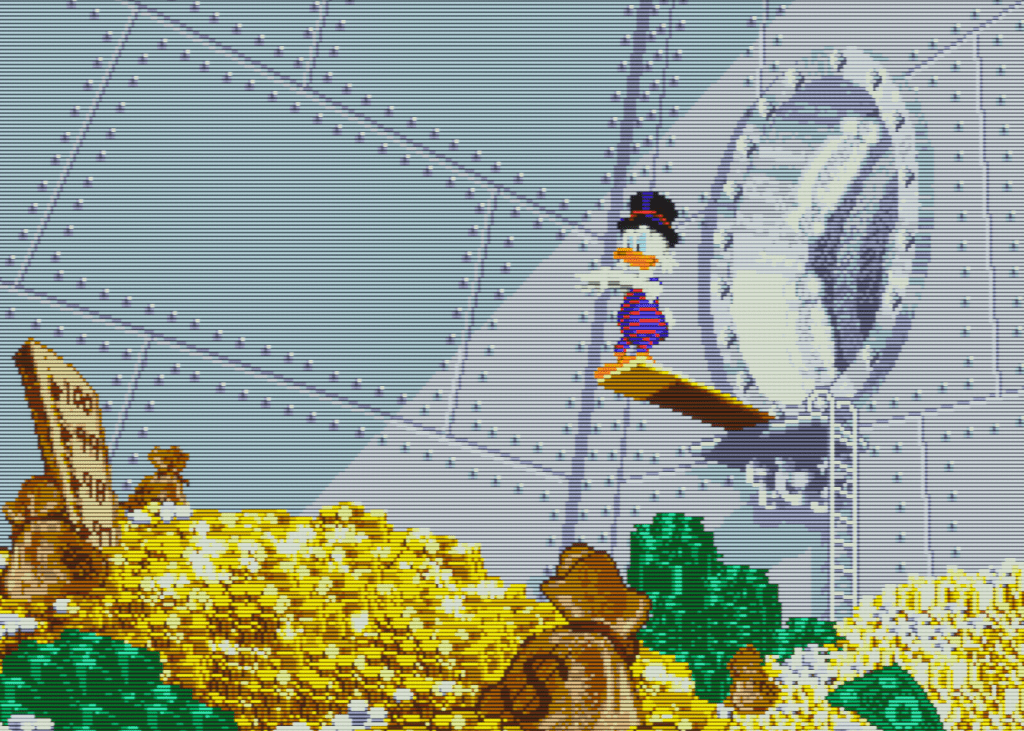
Onto the Money Bin. If you’re familiar with the cartoon, then you’ll recognise this as the vault of wealth that Scrooge dives into. Here, it’s something of a gambling mechanic with a chance to find a lucky coin worth $1000. You hit the fire button, and Scrooge will dive off into his hoard, re-emerging a few seconds later. If you’re fortunate enough to win one before you leave Scrooge’s Office on day one, you can invest in some shares right away.
The manual advises you to hit up the Money Bin every time you’re back in Duckburg, and it’s solid advice.
Off and Away in Our Magnificent Flying Machine

Onto the main meat-and-potatoes of the game, and where you’ll primarily compete against Glamgold: globe-trotting, and racing against time to seek and claim famous treasures.
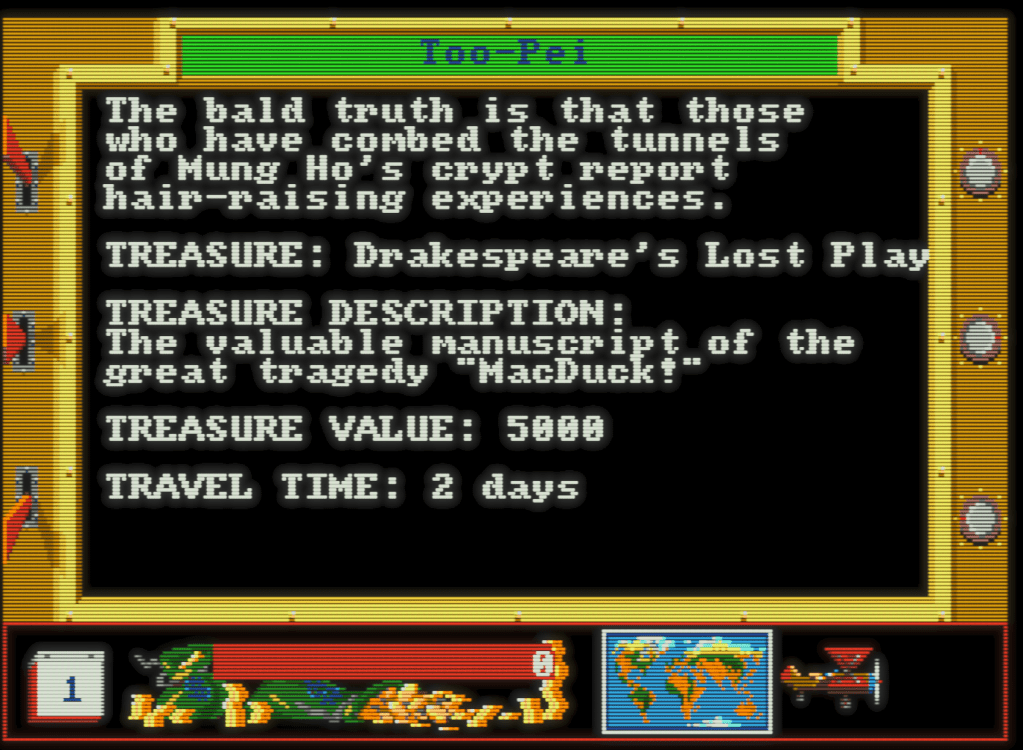
Oof. Too-pei? Drakespeare? Boo! The gentle dad humour continues with the names of the places you can fly to. Each location will take a certain number of days to reach, so time management becomes key. Especially so on harder difficulties, you’ll need to make sure you spend your time wisely to get the most ‘bang for your buck’. The descriptions accompanying each location also clue you in on the type of adventure you’ll have there: Mountain Climbing, Jungle Survival, Cave Exploring, and Nature Photography. And believe me, once you’ve played Quest for Gold long enough, you’ll have a personal sliding scale of which you want to do!
Before you embark on your treasure-seeking, you’ll need to be flown there by ace pilot Launchpad McQuack. On the Amiga version, you get some nice voice samples for each character taken from the show.

Unfortunately, you’re off to a wee bit of a rough start after all the charm and graphical flair.

On the Amiga version, the frame rate is stuttery with unpleasantly jerky scrolling. The Commodore 64 fares better with smoother scrolling but suffers from the same twitchy controls. Together, they knock some points off the score of an entertaining little arcade sequence when you must fly from left to right, avoiding obstacles like clouds, hot air balloons, elastic telephone lines, mountains, and appliances being dropped on your head. If you and Glamgold are heading to the same site, you’ll have to race them there, too.
Whenever they secure a treasure ahead of you, the miserly duck will appear to gloat at you.

Cave Exploring
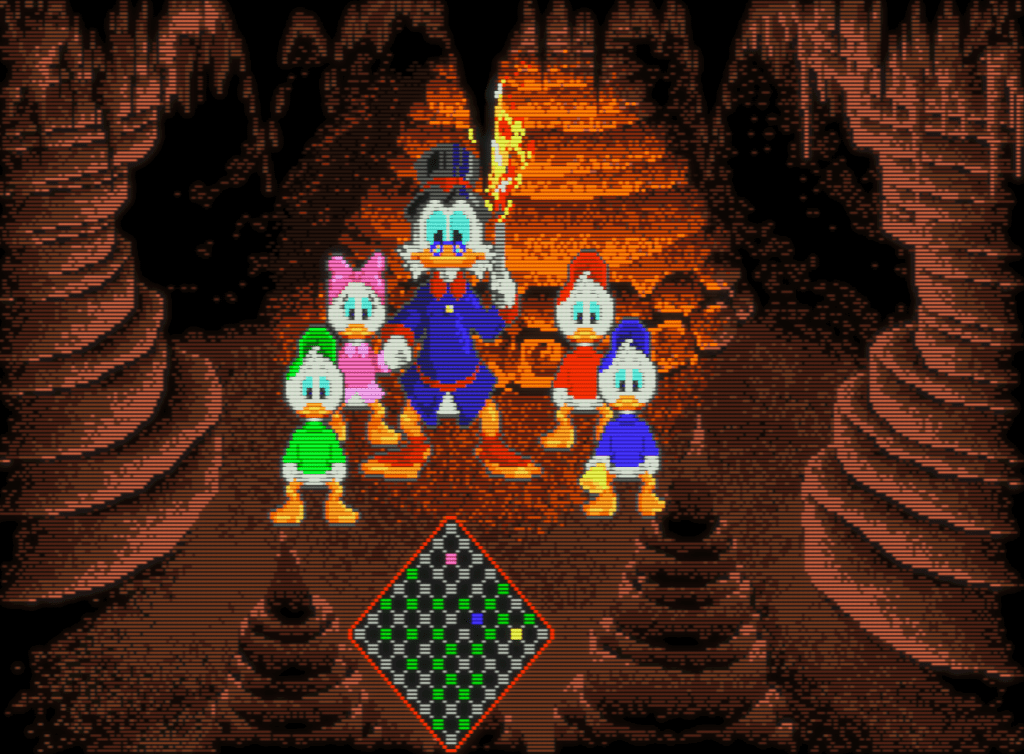
This is the adventure mini-game that I heard the most nostalgic chat about from those who played Quest for Gold. It’s another example of the game’s graphical prowess, especially on the C64, where some truly large sprites get pushed about. On the lush Amiga version pictured above, you get a full party of ducks and ducklings and some lovely lighting effects. Not so on the C64 version (below), which has a colder and spookier feel where it’s Scrooge exploring alone. Which, honestly, is the more responsible thing to do given that there’s a mummy wandering about. With this being a kids’ show/game, however, Scrooge and the rest of the duck squad will always be rescued by Launchpad. Your only penalty will be wasted days, and not some terrible fate.
Cave Exploring takes place in a maze plotted out on a grid. In the way between you and your goal are bottomless pits and the lone mummy stalking the labyrinthine underground.
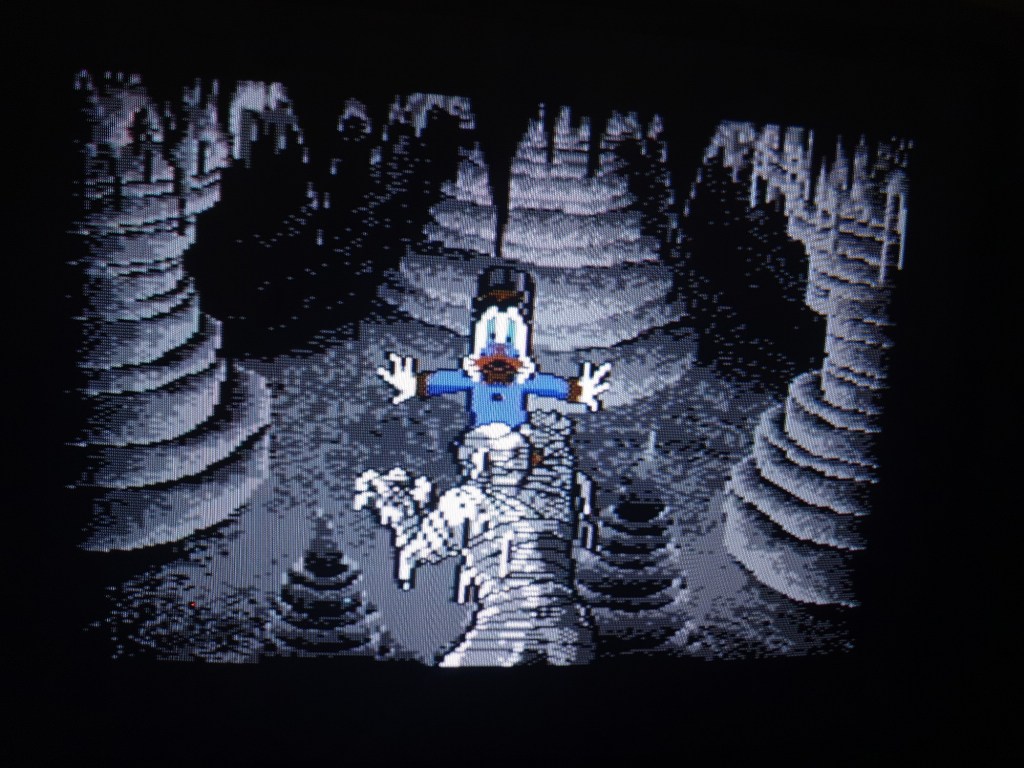
To navigate the maze successfully, you need to look out for the green slime on the walls that highlights where a pit trap will be. Only by carefully charting and deducing a safe path will you make any progress, which will be hampered in real-time too by the wandering mummy and your torch only having a limited duration. Make too many moves and it’ll go out, requiring you to try again with a time penalty. It’s quite atmospheric and overall, the best of the mini-games on offer.

Nature Photography

Here, Webby steps into the limelight armed with her camera. Nature Photography is something of a shooting gallery game in terms of mechanics, with you turning her left, right, and forward and taking a photo with the fire button. Animals will appear and disappear; it’s up to you to prioritise which ones you take photos of and do so quickly enough!

It’s a pleasant little mini-game, though you’ll rarely earn as much coin as you do with the others due to its gentler level of challenge.
Mountain Climbing
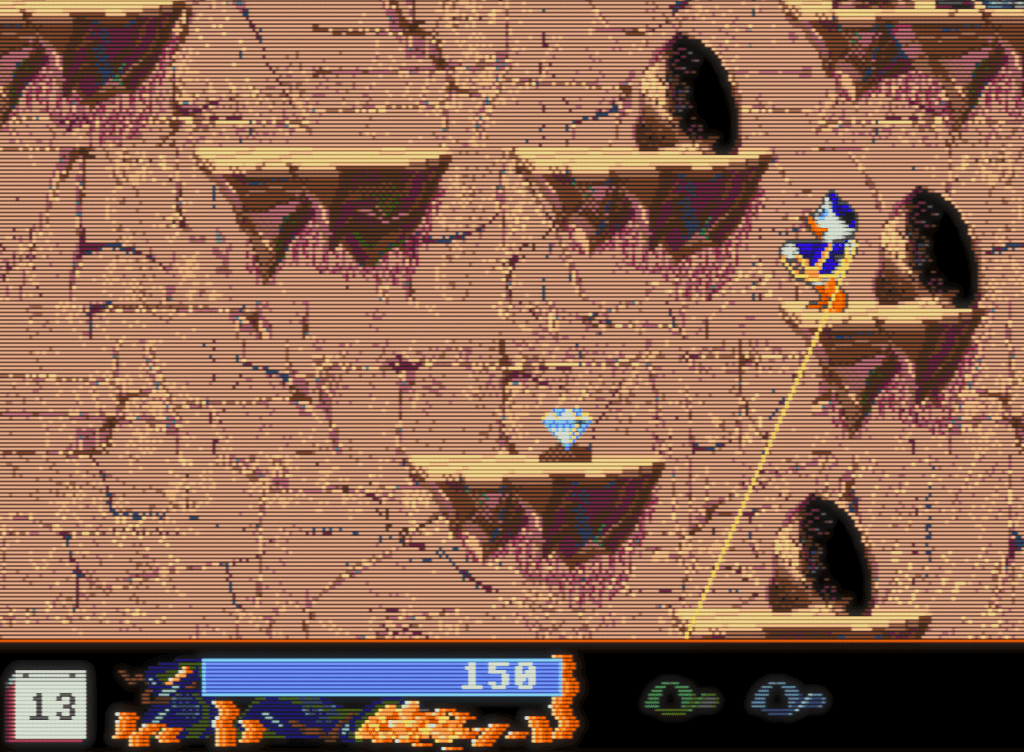
Oh boy, this is my least favourite challenge. In this one, you must guide Huey, Duey, and Luey (they act as your lives) up a vertical rockface, all while avoiding hazards such as the rolling boulders and the Beagle Brothers. Entering the correct cave entrances and employing your grappling hook successfully will lead you to the goal.
Unfortunately, the choppy scrolling, plodding pace of the ducklings’ movement, and lack of checkpoints really hurt this one and turn it into an exercise in frustration. You’ll end up shaking a fist (or worse!) at the screen each time you’re sent all the way down to the bottom. The way you use the grappling hook can also lead to annoyance; you set it spinning around and then have to time when to hurl it forward, all while you bleed momentum in your swing.
Jungle Survival

The original Pitfall is what I first thought of when we played this mini-game. This time, you’re guiding the ducklings across jungle platforms and using springy branches and swinging vines to progress, all while avoiding sleeping animals and other hazards.
If this and Mountain Climbing were released as separate games and reviewed on their individual merits, I feel they’d be considered sub-par. There is less frustration to be found here than in Mountain Climbing, but the choppy scrolling and stiff controls detract from the experience.
Dime Duck of the Year Goes To…
On the 30th day, whoever has the most money in their challenge account wins. Regardless of the outcome, you’re treated to some more lovely cutscenes.

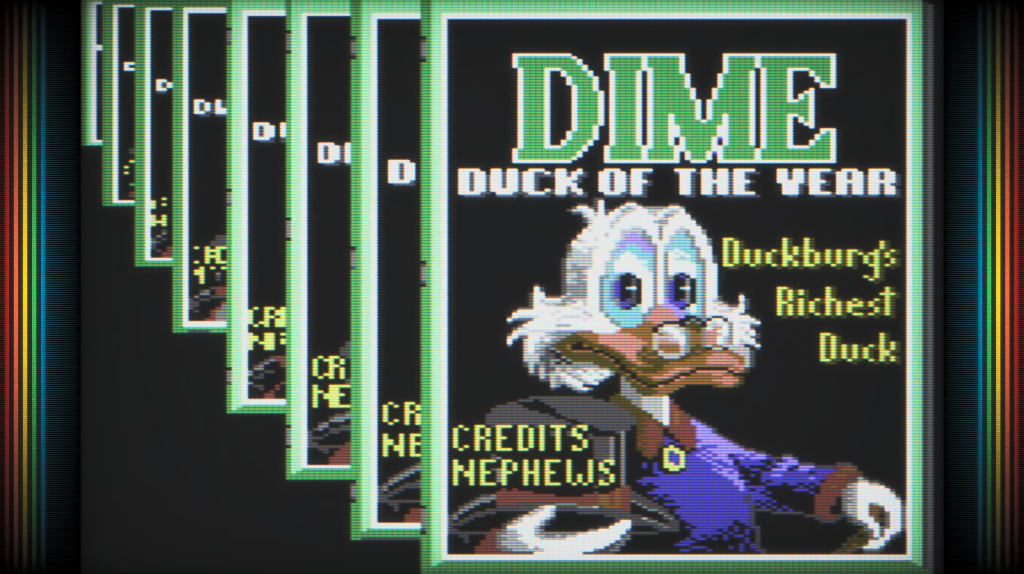
And that’s it, you can choose to start another game, perhaps at a higher difficulty. Depending on the adventures you choose to go on, you’ll complete a game of Quest for Gold in an hour or two. And I think that’s the best way of treating it, as a board game session. It would have actually made for a decent competitive multiplayer game with each player taking the role of Scrooge or his rivals and taking it in turns to perform an action per round.
Closing Thoughts
There is a lot to like about Quest for Gold, and I can see why there was such fondness (as well as surprise from those who hadn’t seen it before!) when I showcased a snap of it on BlueSky. Even more so than the more-famous NES game from 1989, it feels like you’re going on a Duck Tales adventure with some of your favourite characters from the comics/TV show.
Unfortunately, I can see why some people are a little snarky when they compare it to the NES game they knew and loved. After doing them even just once, the Mountain and Jungle platforming sections feel more like things you put up with rather than truly enjoy. And that’s effectively a 1/3rd of the game! You’ll arrive at the treasure chest at the top of the Mountain’s vertical stage with a feeling of relief that it’s over, rather than relishing the idea of doing it more than once per playthrough.
Despite my criticisms, I would recommend Quest for Gold. The sum of its parts is greater than the flaws of the individual ones; it’s a charming adventure with some of the nicest cartoon graphics of its era and oodles of Duck Tales charm and flair. All it needed was refinement of the platforming elements and smoother scrolling for me to give a full-throated recommendation.
If you’ve enjoyed this article and would like to support me in writing more long-form features, Pages of the Past, and Adventure Logs, then you can do so on my Patreon, via Kofi, or by picking up copies of my digital zine, Between the Scanlines.
Thank you for reading, and I hope to see you next time!
 Scanline Artifacts