


I love stuff like this that sends me careening down rabbit holes, like the Reem-chan mascot for Dreamcast did a few months ago. Here I am again, this time with something from Nintendo’s past: the Famicom Adapter.
Now, this sounds like a device that already exists, right? ‘Famicom Adapter’ has the ring of something you plug into a Nintendo Entertainment System to play import Famicom carts. No doubt there are things called Famicom Adapters that do just that. But no, this is something else that may still exist, albeit stored away in one of Nintendo’s vaults or in the basement of an ex-Nintendo staffer. Reggie, time to fess up and let us play with it, too!
So, here we go. Let us grab hold of the first thread, following it down through the time portal all the way back to 1988.
Here comes the Super Famicom
The Nintendo Famicom was getting a wee bit long in the tooth by the time 1988 dawned. Released in 1983, it had been given a shot in the arm by the capabilities of the Disc System and the development of mapper chips, but there were now fresher and hungrier wolves circling Nintendo’s hen house. The PC Engine, NEC’s hybrid 8 and 16-bit console, had made a splash the previous October, and there were already plans to release a CD add-on for it in 1988. And Sega were poised to unleash their 16-bit Mega Drive later that year. Together, they were ushering in a new console era in Japan – one that threatened to leave Nintendo behind on the technical front.
It’s no surprise, then, just a month after the release of the Mega Drive, that Nintendo unveiled the successor to the Famicom in November 1988: The SUPER Famicom.

It’s in this issue of Famicom Tsushin Magazine (published in December 1988) and its special report on the Super Famicom that we follow the thread down into the rabbit hole. Not only do we get some visions of an alternate SFC with different livery, eject button, and controller ports (plus some odd-looking sliders), but we see the star of this article: The Famicom Adapter.
The Famicom Duo
I’ll extend heartfelt appreciation to Chris Covell, whose photos of their copy of this otherwise seemingly unscanned issue feature in this article. They also provided some commentary and speculation that aligned nicely with my own research yesterday.
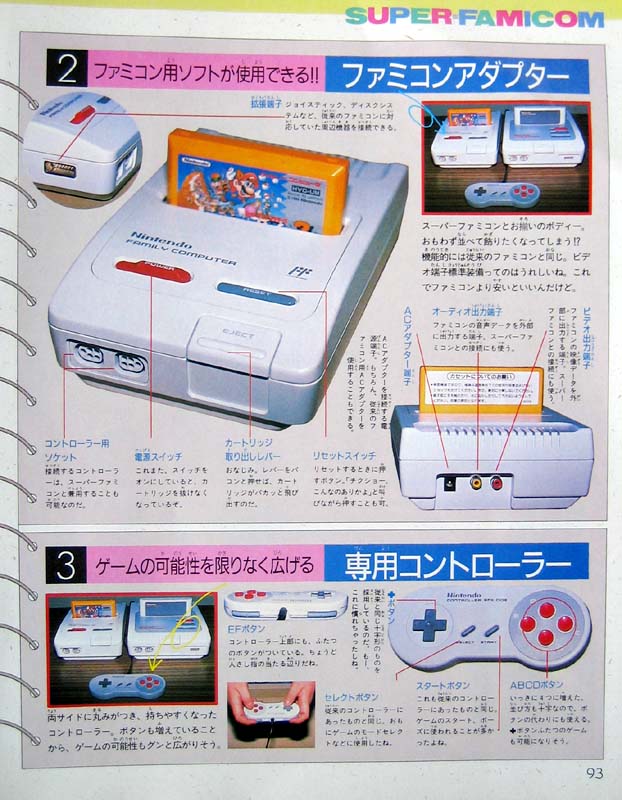
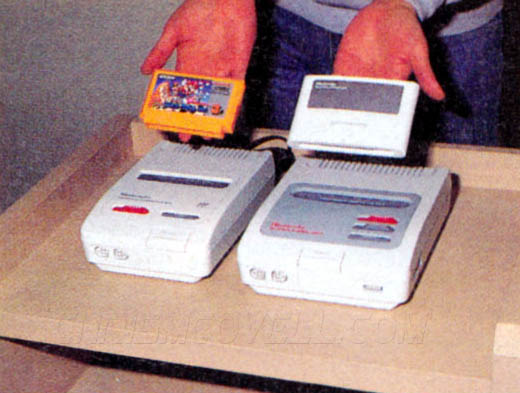
See what looks like a squashed, boxier SNES next to the Super Famicom? That’s the Famicom Adapter, a proposed redesign of the Famicom five years before the Top Loader. Now, that would be cool in itself, a lost prototype redesign (one that I vastly prefer to the Top Loader, my least favourite console design!), but here’s the fascinating part: not only would it have been a standalone console, the Famicom Adapter would have been designed to connect to the Super Famicom.
Even if you’re only passingly familiar with 16-bit consoles of the late 80s and early 90s, you know connecting an additional bit of hardware, usually to provide access to a different form of media (such as CD), was pretty common. So this is not an outlandish idea. But in the case of the Famcom Adapter, it’s connectivity with a prior generation of console hardware. But for what possible purpose?
Armed with spotty fluency and Google Lens, I pored over the above page from the feature yesterday, the only one I had from an archive, as I shared it on BlueSky. And was surprised to see mentions of not only audio/video connectivity between the Famicom Adapter but also data.
This set off a bonfire of possibilities in my head. You’ll notice that there is only one controller in front of the two consoles; does that mean you only need to use one when they’re connected up?
The article text makes much of the stylish nature of having both of them side-by-side. They certainly have an attractive, artsy vibe with a brighter bluish-white casing colour, so I can totally get behind the magazine finding that appealing.
Aesthetics aside, here’s where we get into the nitty-gritty on the technical side.
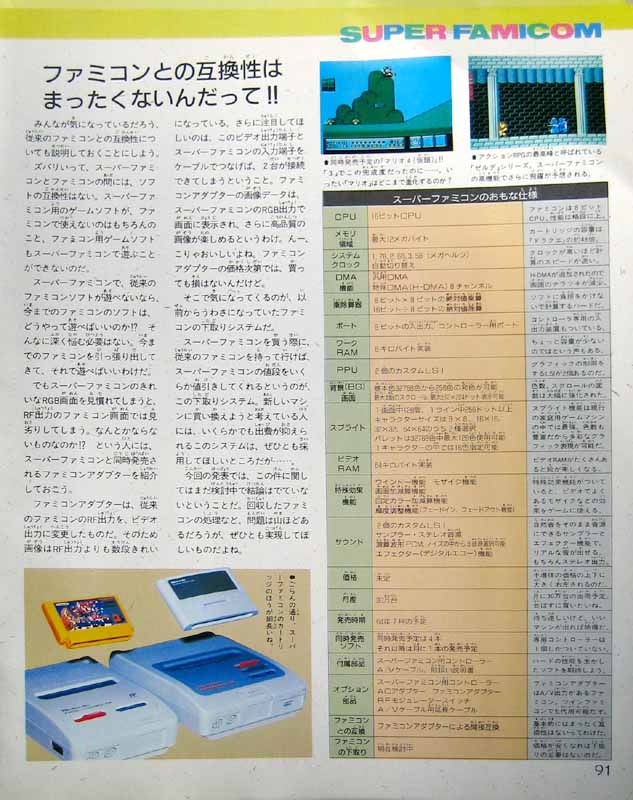
This page starts off emphasising that the Super Famicom is not directly compatible with Famicom carts and vice versa. But then they coyly muse: how do you play your old favourite Famicom games?
Of course, the easiest solution is to just play your old Famicom, they remark matter-of-factly. But, they say, leaning in to whisper seductively into your ear, once you’ve seen the beautiful RGB output of the Super Famicom, the dirty RF output will never feel the same way again. What if… you could play your Famicom with the same higher video signal quality?
You can with the Famicom Adapter.
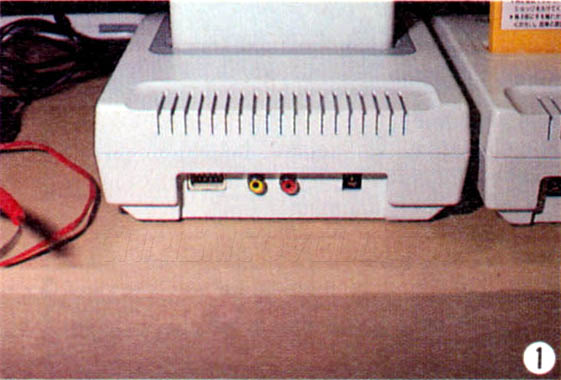
Yes, you’re reading that right. The connectivity between the Famicom Adapter and the Super Famicom would act as a video and audio signal pass-through to the Super Famicom, which would then output via the multi-out port to your TV. That’s why there are those sliding buttons on this iteration of the Super Famicom; one of them enables the A/V pass-through from the Famicom Adapter. The audio/video ports are inputs, not outputs.
We also get a good look at the Super Famicom’s proposed controller, which would be compatible with both the Famicom Adapter and Super Fami.
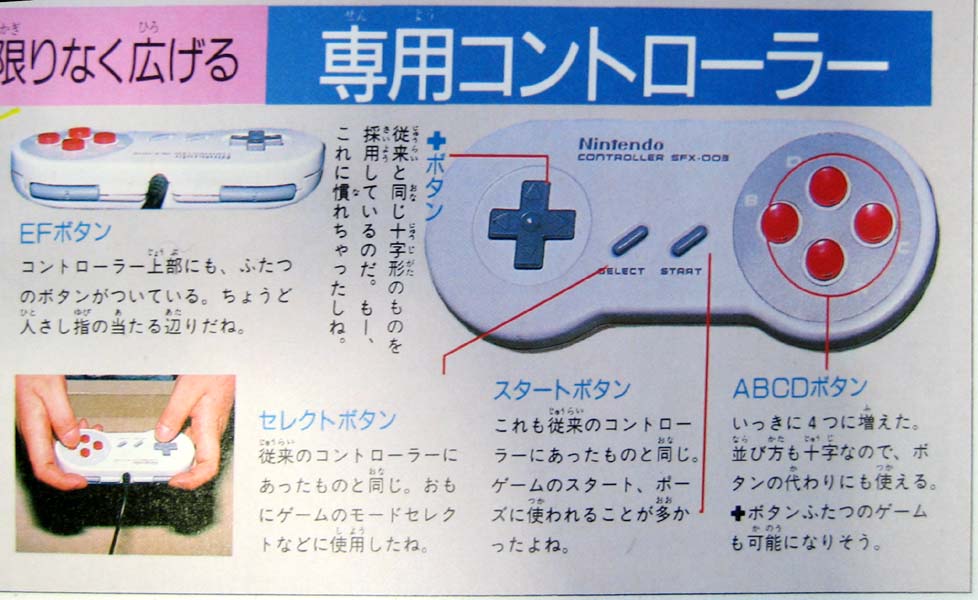
As you can see, it would use an all-red face button design, labelled ABCD. Shoulder buttons would be E and F.
I haven’t been able to confirm if input connectivity was a thing, but I don’t think so, given the lack of an additional cable port that would carry the input signals. Cable tidiness and that tantalising improvement in video quality seem to be the main features of this duo.
A Short-Lived Pairing
The Famicom Adapter appears to have been a short-lived pipedream. By July 1989, the Super Famicom looked almost identical to the release version, and the Fami Adapter no longer appeared next to it in features.
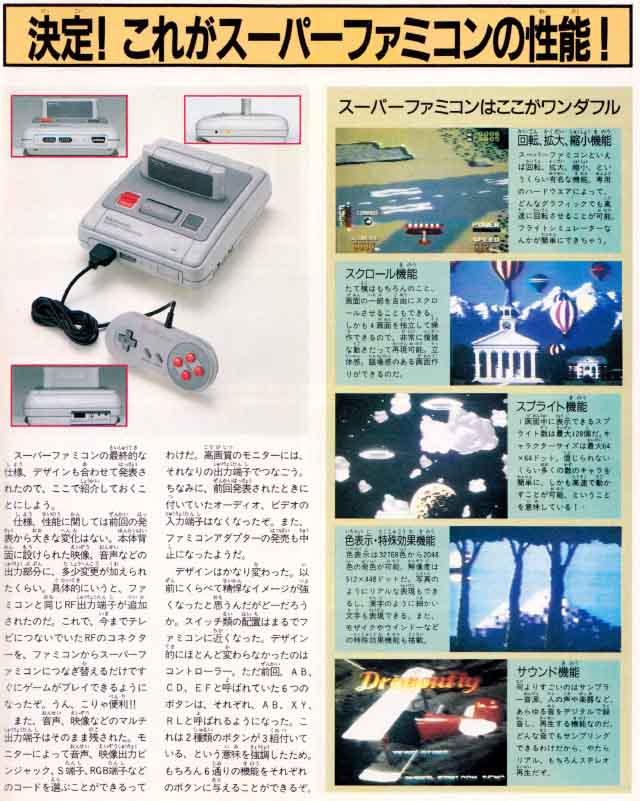
This feature from Famicom Tsushin does mention the Famicom Adapter, but only to say that plans for its introduction have been abandoned, and that the audio/video inputs that it would have plugged into are now conventional outputs to allow buyers to plug in their old Famicom AV cables without having to buy a new multi-out.
So yeah, that’s the story of the Famicom Adapter! It’s a fascinating little what-if and example of backwards compatibility done another way. If it had been released, could there have been a version for the Super Nintendo? The fact that you couldn‘t play Nintendo Entertainment System games on it was a sticking point for some North American parents, outraged and convinced that Nintendo was scamming them by introducing a new console.
Imagine that these days, eh?
Heartfelt appreciation to Chris Covell and his treasure-box of a website for forming a core part of my research into the Famicom Adapter. I recommend checking out his site, as not only does it have a cool presentation, but there is a lot of valuable stuff following the development and media coverage of various consoles.
If you’ve enjoyed reading this article and would like to support me in writing more long-form features, Pages of the Past, and Adventure Logs, then you can do so on my Patreon, via Kofi, or by picking up copies of my digital zine, Between the Scanlines.
 Scanline Artifacts