


Zany. Surreal. Referential. Dated.
All these terms—and more—can be applied to the latest Scanline Artifact I’ve delved into for investigative purposes: the Superhero League of Hoboken. But, you know what else can be used?
Endearing.
The Future Ain’t What It Used to Be…
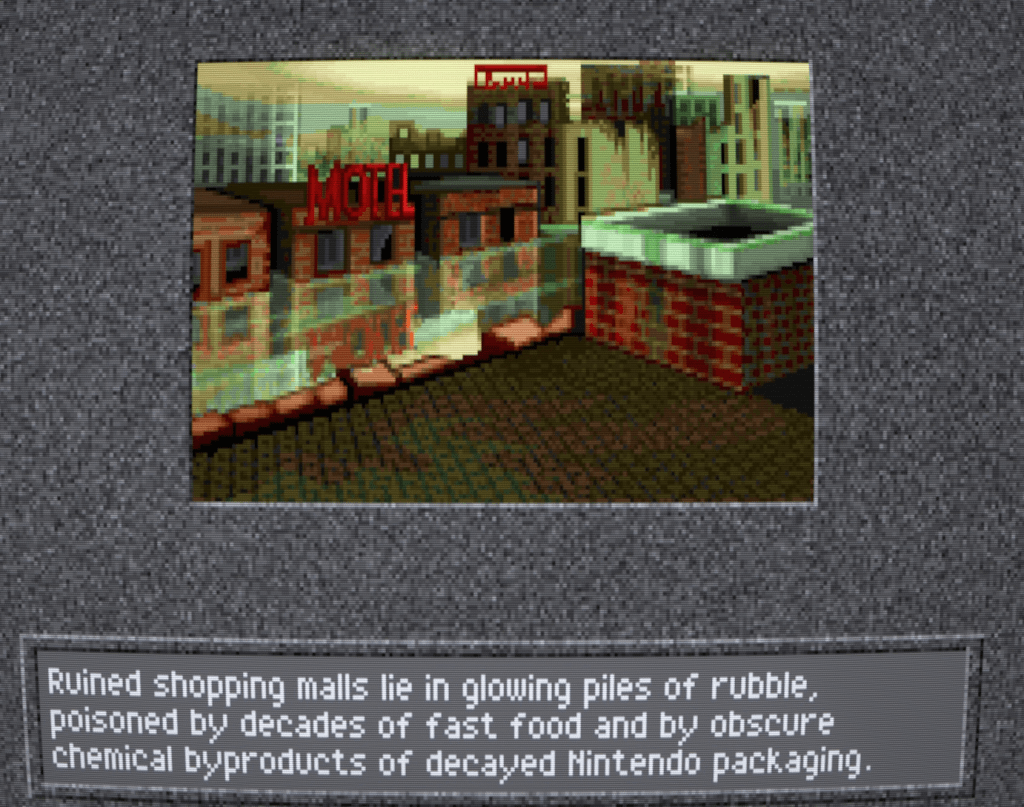
Superhero League of Hoboken takes place a couple of centuries from the then-present day of 1994. Alas, this is no shiny future of optimism and flying cars, but one set in the ruins of a fallen America devastated by environmental and atomic catastrophe, runaway artificial intelligence, genetic tinkering, and a shortage of oat bran.
If you went into Hoboken completely blind, this is your first clue that this game isn’t playing it entirely strait-laced about its setting. The tongue-in-cheek nature of Hoboken more overtly and referentially presents itself, referencing the chemical byproducts of decayed Nintendo packaging being part responsible for the state the world is in and that one danger roaming this crapsack world is a mutated fast food mascot with a suspiciously familiar logo and colour scheme.

This might be a good time to introduce the mind behind Hoboken: Steve Meretzky. Now, to anyone with more than a passing familiarity with Interactive Fiction, this is a name you will already recognize. For everyone else, Steve Meretzky was one of the ‘implementors’ at Infocom, who led the charge in the early 1980s to popularize what are commonly known as ‘text adventures’. He initially joined the company as a game tester, but in 1983, fate landed him the role of scripting their latest release, Planetfall. It was in that game that Steve’s talents for witty writing and clever coding were first demonstrated – and a pattern emerged.
The Hitchhikers Guide to an Infocom Implementor.
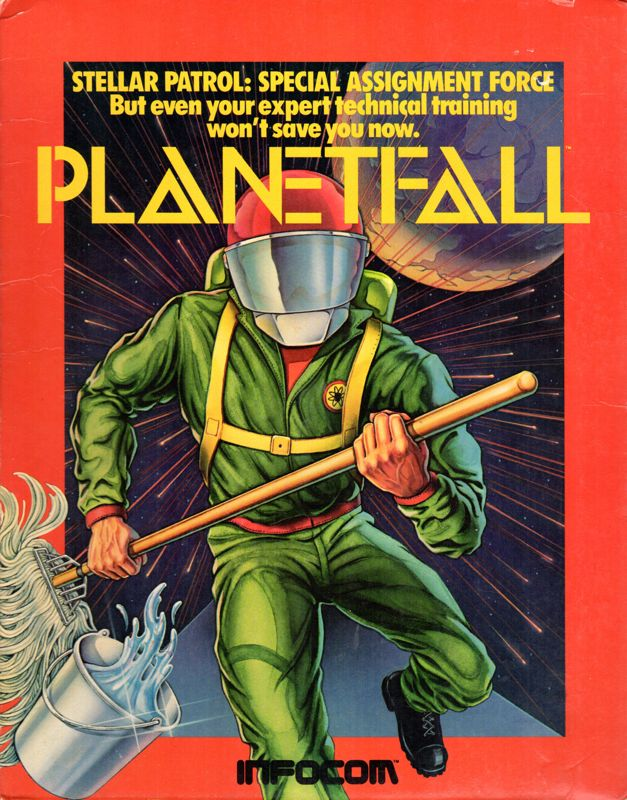
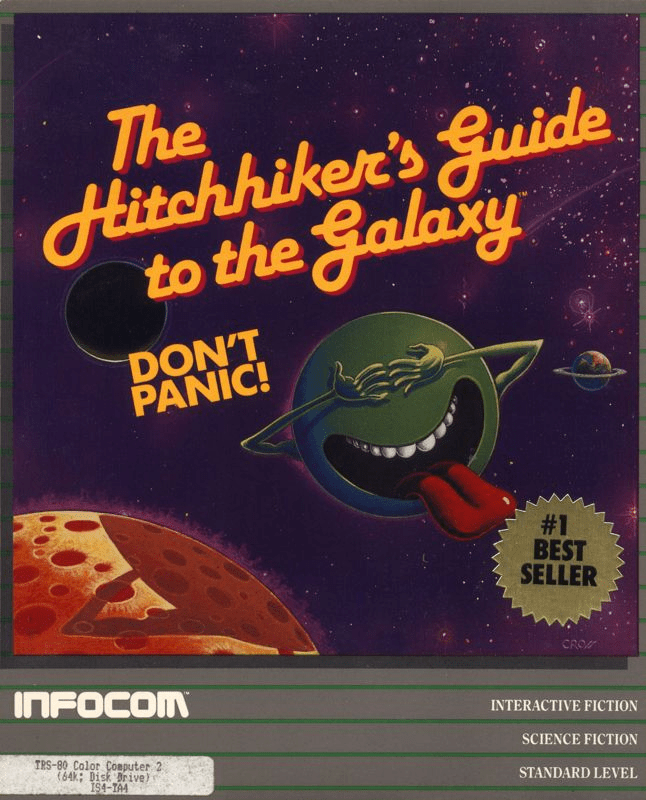


Casting your eye over the games written by Steve Meretzky, you’ll notice similarities in subject matter and tone. Steve’s love of satire, puns, and referential humour shines through in the writing and puzzle design of these games – as does sporadic forays into social commentary.
One of them, A Mind Forever Voyaging, is not a light-hearted adventure. It is a biting critique of the Reagan era. A warning to history about the dangers of puritanical moral and religious fundamentalism, conservatism, and unchecked environmental and industry deregulation.
It’s worryingly relevant again today.
AMFV is my favourite piece of Infocom Interactive Fiction, even if it is the least interactive of their stable of text adventures. So, when I started playing Hoboken and noticed Steve’s name associated with it, my reaction was simply “Ohh… that makes so much sense!”.
Welcome to Hoboken, New Jersey.

As with Fallout‘s post-apocalyptic setting, the Old World left its mark on the new one rising from the sludge in strange ways. One of the more prominent examples is the ‘Superhero Leagues’ that have arisen. Armed with old comics and radio serials, those with bionic augmentations and strange mutations have banded together with a mission: to nurture the rebirth of a new society, to ease the suffering of the dark age, and to… provide a place where superheroes can always find a date on a Saturday night.
In this world of costumed superheroes, Elvis-worshipping cultists and sentient farm machinery run amok, the player assumes the role of The Crimson Tape, the recently appointed new leader of the small and almost-forgotten Superhero League of Hoboken. Its Superhero League sank into obscurity under the tenure of your incompetent predecessor and is now a mere fourth-rate, level one league. That’s right, the Superhero Leagues have a high-score table and you’re right at the bottom. Way at the bottom.

This ranking system and the points you’ll amass is one callback to Hoboken’s text adventure heritage. You would have a score tally and be awarded a title whenever you died or when you completed an Infocom text adventure. Achieving a perfect score was one way they encouraged replayability. As I learned through playing Hoboken from start to finish in a couple of weeks, it does things a bit differently, but we’ll come to that.
Superheroes, eh? Sounds exciting! Uh, well, it depends on how specific you enjoy your superhero powers. The Crimson Tape’s superhero power is, well, being able to quickly draw up really good organizational charts. Tropical Oil Man, one of your comrades in arms, can raise someone’s cholesterol level with a mere thought. The Iron Tummy? He boasts the ability to eat incredibly spicy food without batting an eyelash. Captain Excitement? He’s so dull and boring that he can put opponents to sleep.

Hoboken’s brand of superhero powers is as tongue-in-cheek as the setting itself. You’ll also notice from Iron Tummy’s inventory that he starts with gear that wouldn’t look out of place in an Earthbound character’s. That’s right, you’re going to be fighting crime by jabbing people with a rusty nail and firing a pea shooter at them, all while dodging in a pair of ballet dancer’s shoes.
It’s all part of the off-beat charm of Hoboken, and the steady climb from planks of wood and plastic capes to neutron swords and force-field projecting earrings is one of the most fun aspects of the game. Gear and stat progression fans will have a blast with it.
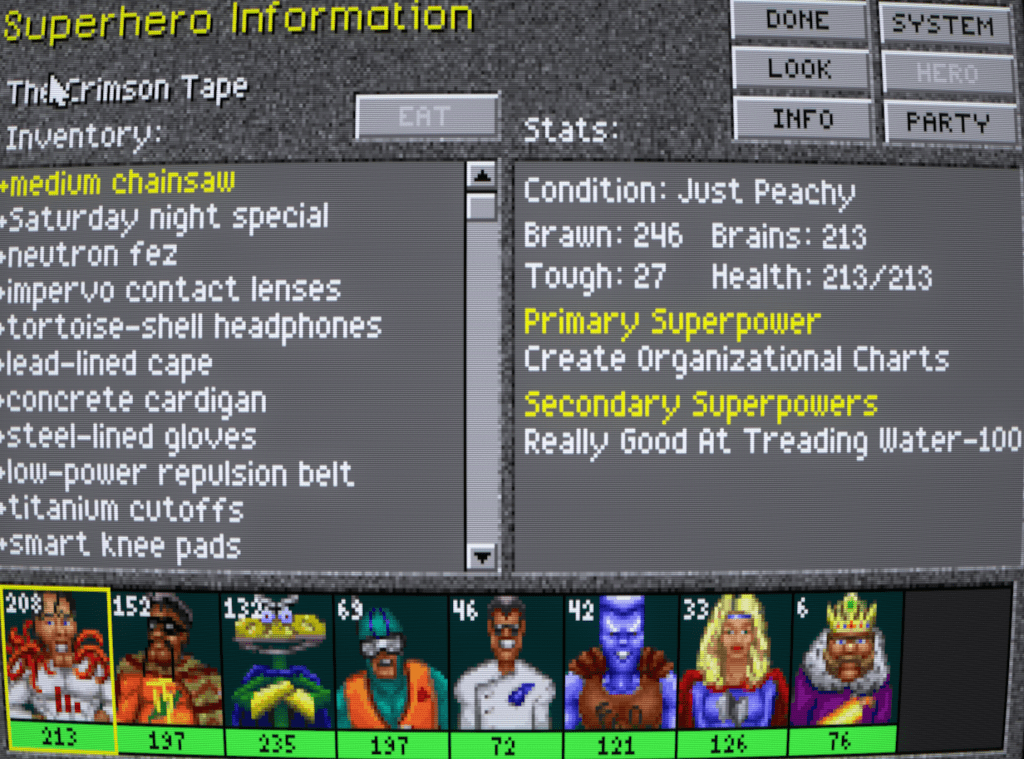
The gear names are wild and wonderful, evoking vivid images of how strange your superheroes must eventually look as they bestride the wastelands decked out in gear that would make a Bethesda Fallout protag marvel at their weirdness.
As you’ve likely already surmised from the screenshots above, this game is an RPG. But, it’s also an adventure game! Publisher Legend Entertainment’s titles often bestrode different genres, fusing them into a polyglot whole. Hoboken is no different. It is as much a puzzle-solving adventure as a stat and combat-driven roleplaying game.
You start off in your superhero league’s headquarters, hidden away from public view like all good HQs. It’s there you’ll get to grips with the interface – and hopefully marvel at the first example of Hoboken’s gorgeous VGA artwork.

Artists had really gotten to grips with VGA by 1993, even as successor SVGA loomed on the horizon. I adore VGA artwork from this time; Hoboken joins my list of favourite examples of how gorgeous it can look. And if you had an an MT-32, then your ears are in for a treat too. The music that plays in the HQ is also now one of my favourite examples of how much Roland sound could elevate a soundtrack over Adlib/Soundblaster.
Oh! If you’re playing the CD version, there’s voice acting! Pretty decent VA for the era, too and a surprising amount of it. It really adds to the goofy nature of the world and your missions and for anyone emulating it or burning an iso for use on real hardware, I absolutely recommend it.
Okay, one thing you’ll have noticed from the screenshot above is that you also receive a text description of the location you’re in. This is another artifact of the purely text-based Interactive Fiction era. Not that it’s unwelcome; it’s prosy and evocative and adds to the humour and worldbuilding. Some of it does feel redundant, though; Hoboken will list items that are stored in your locker and tell you which superheroes are present in what can be long, ultimately redundant paragraphs. The locker contents information (“…a screwdriver, an atomic muffler, a two-by-four, a see-through vest…) is particularly useless as you can open it and just interact with and see the contents there.
In these ‘adventure sections’, you’ll interact with the world with verb commands, most of which will be appropriately pre-selected when you hover over an object or person. You’ll move through the world by selecting the arrows or keypad directionals. It’s intuitive stuff and rarely feels cumbersome or steers you in the wrong direction.
After heading to the Lunch Room and selecting a party of mutational misfits (a maximum of four to start with), you’ll head up to the Mission Room where Matilda, your computer assistant awaits with a bank of missions to be completed.

As you can see, these missions aren’t your usual run-of-the-mill superhero story perils. Rabid sheep terrorising a village? A Limburger (cheese) bomb? A cache of jalapeno peppers threatening to turn the local water table too spicy to drink?
It’s all a bit silly, and again, that’s what I found so endearing and enjoyable about Hoboken. They’re the kind of misadventures Roger Wilco of Space Quest fame might find himself embroiled in. And sometimes, you’ll immediately spot which of your coterie of strangely specific superpowers will come in useful.
Each bank of five missions is an ‘episode’ in the story of the Superhero League of Hoboken and once you’ve completed them, you’ll be rewarded with a short intermission and completion bonuses – and an advancement up the table of Superhero Leagues!
> Examine Puzzle Design
If you’re familiar with adventure games of the time, you’ll no doubt be wondering if Hoboken is one of those games. You know, the ones with ‘walking dead’ and unwinnable states you can get yourself into. I’m happy to report that, refreshingly, Hoboken has zero no-win states. You can’t lose or misuse an important item. The Undo button is there more for convenience than to save yourself from a mistake as the puzzle design is extremely friendly for the time. I haven’t played any other Legend Entertainment games, so I can’t say whether or not that’s just something they rolled with or if it’s just this game in particular that says “Hey, just sit back and enjoy the gags and references and do a bit of gentle puzzling. Relax. There’s no unstable ordinance or forgetting police procedure here.”
I truly appreciated it and it’s part of why Hoboken won my heart pretty quickly.
> Examine World
Hoboken’s world is a fascinating one. It’s a hodgepodge of post-apocalyptic tropes wrapped up in pop-culture references and occasional social commentary. You’ll move around and explore it via a top-down tile-based graphic interface that wouldn’t look amiss in a city builder.
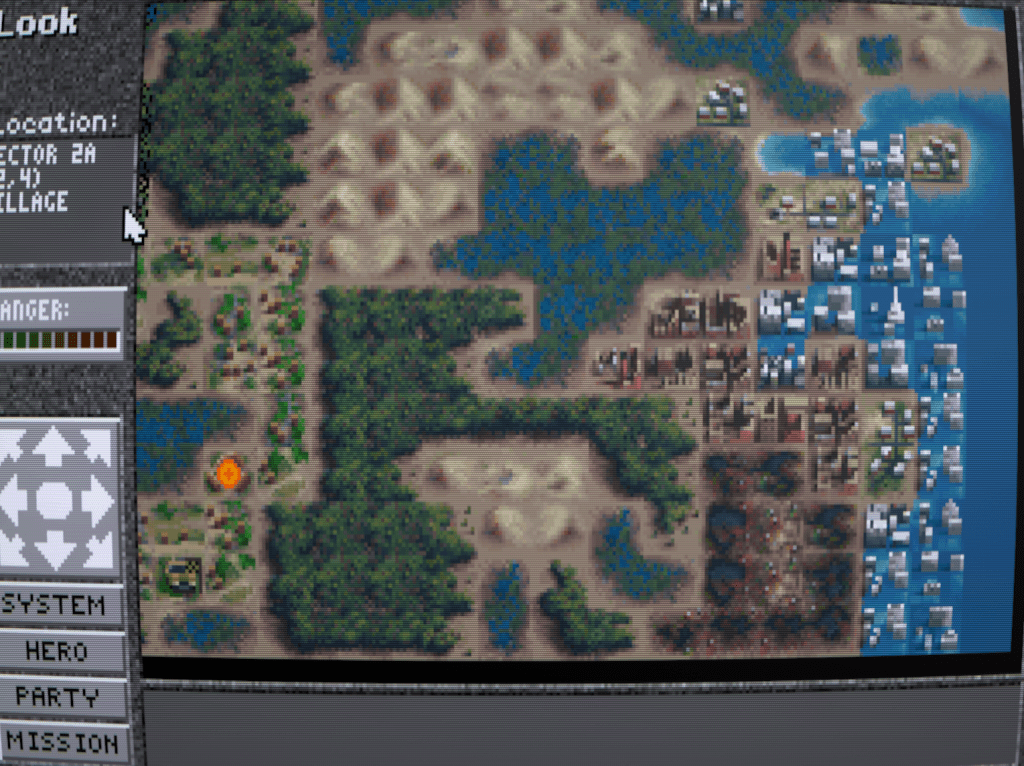
Amid toxic swamps, radioactive deserts, and flooded metropolises, you’ll find pockets of crude civilization, the city-states as they’re rather optimistically termed. Each city-state has a central hub marketplace and is ruled over by a warlord.

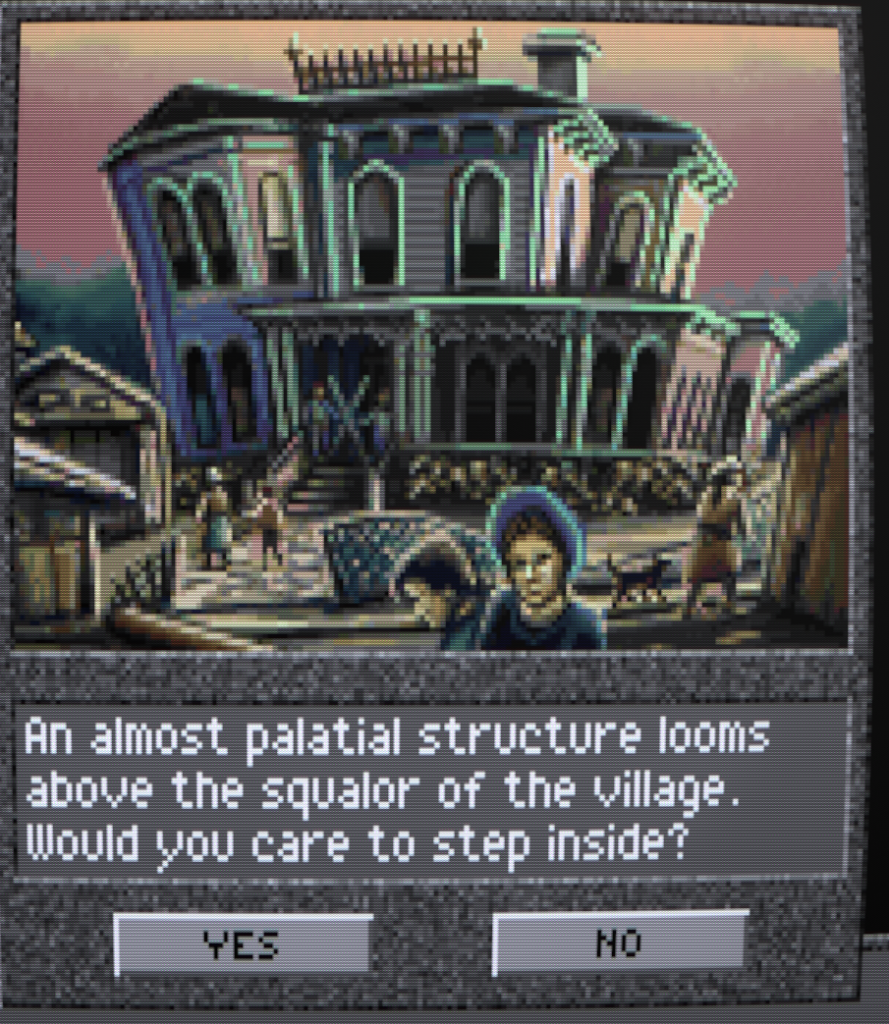
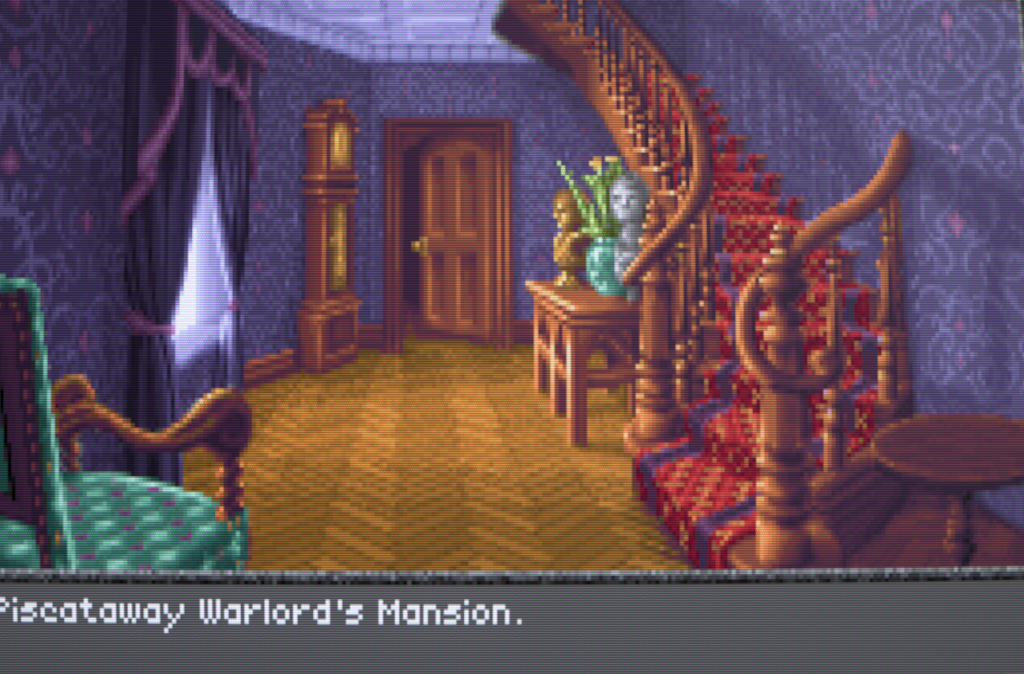
These marketplace hubs mainly serve as places to buy gear, heal up and replenish supplies – and purchase important plot items from the Pawnbroker. They’ll also sporadically serve as the places you’ll need to solve mission-critical puzzles if one of the missions is a city-state calling out specifically for aid.
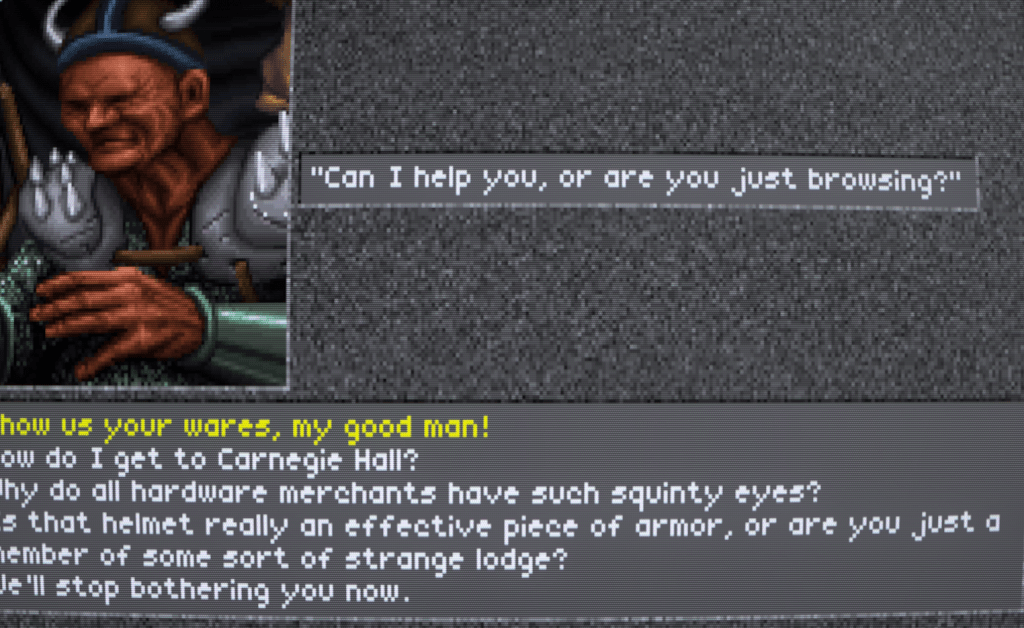
It’s here where I’ll get one of my main critiques of Hoboken out of the way: every city-state marketplace and merchant NPC has identical artwork and the same text descriptions and dialogue. It’s something that the game itself lampshades in a few different ways citing budget cuts or coming up with a lore explanation, but I feel that only goes so far. You’ll chuckle at it once and then quickly wish for more variety.
It’s a shame because otherwise, the unique artwork and text descriptors for important zones and landmarks are wonderful. One of my favourites is a church that worships an old mid-90s beige box PC that does nothing but run a screensaver, from which they derive their wisdom and teachings. I’m fond of misremembered history as a post-apocalyptic society trope, so Hoboken rubbed that soft spot in all the right places more than once.

It’s in this wonderland of tropes that we get our now-dated pop culture references. A lot of them. This is where some of the humour and writing of Hoboken may fall flat as it is extremely centric to the time period and to the United States. Baseball stars, crooners, quiz show hosts; they’ll all be trotted out and these days, it’s a dice roll whether you’re old and familiar enough with US popular culture and history to understand the gag.
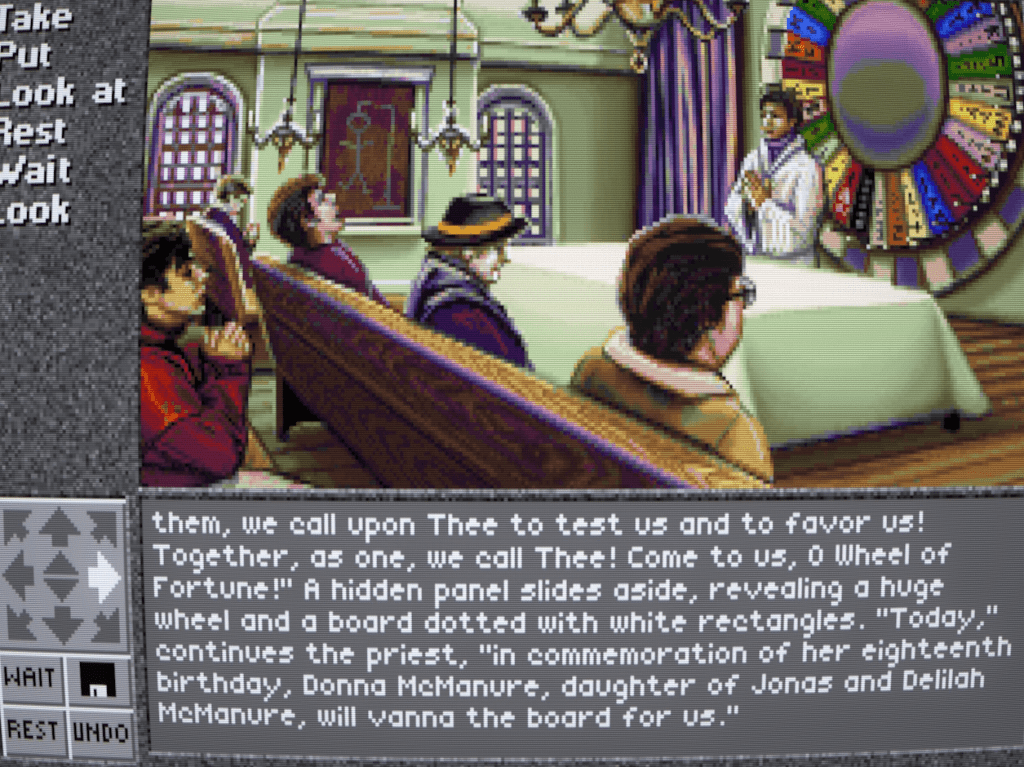
Being someone who is, I got the bulk of the gags and references, letting out a particularly wry chuckle at “… will vanna the board for us.” during the Wheel of Fortune cult scene, but even then, some of them went completely over my head and I had to look up. Thankfully, there’s more than enough basic trope humour to enjoy even if the references do land with a thud.
I’m relieved to report that Hoboken mostly avoids offensive racial or gender stereotypes and sexism in its humour. There’s a little of it here and there, some overly campy voices and one female superhero is presented a little sleazily while another is characterized as undateable because she’s a feminist, but that’s all I made a note of to mention.
> Fight Radioactive Rat
Let’s move onto the stat-based and combat RPG aspect of Hoboken. This falls in line with one of the two types of CRPG of the time that count Wizardry and Might & Magic among its number: first-person, turn-based combat.

You’ll encounter bands of enemies on the overworld map or in the handful of ‘dungeons’ present in the game. Each zone has a danger rating that gives you a heads-up on just how tough the enemies you’ll encounter are likely to be. The game will also take steps to prevent you from stumbling into zones too difficult for you by putting up diegetic exploration gates. You’ll need specific equipment or percentages of superpower to, for example, explore woods or move across water.
The collapse of the old world seems to have given rise to a strange menagerie of life that now roams its ruins – many of them punny and coming with satire in both their descriptions and their attacks. From the Albino Wino and Suggester to the Bureau-crat and Lawyer, the foes usually reference something or someone from 1980s and early 1990s Americana. This again can feel very of its time but can nevertheless be enjoyed in the same way Earthbound‘s sometimes referential enemies can be.
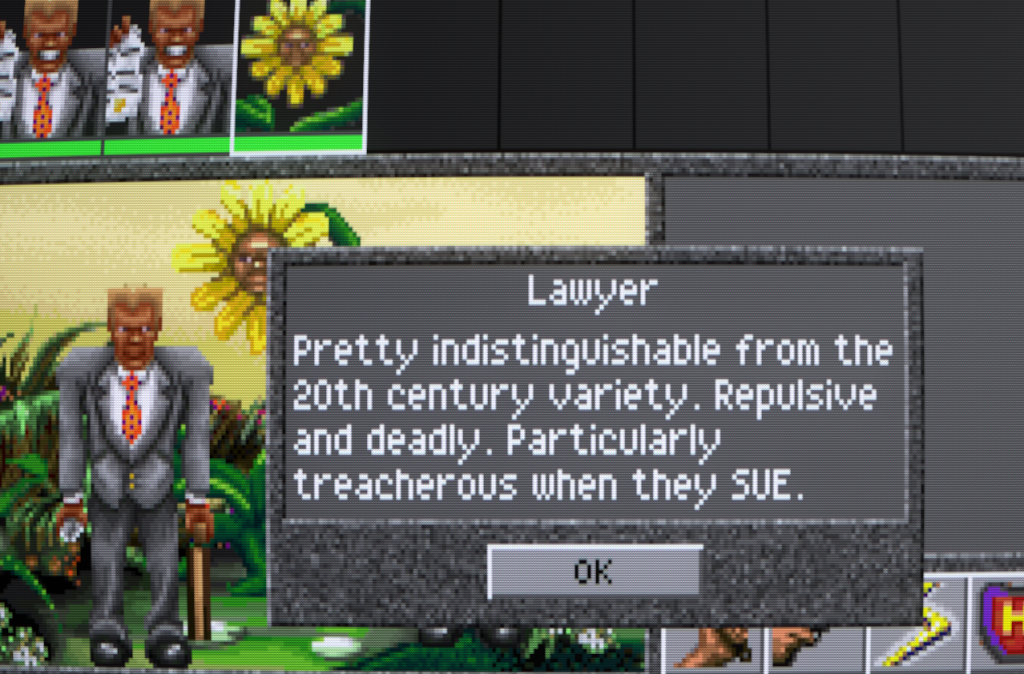
You’ll engage them in combat with a variety of melee and ranged weapons – and superpowers. And this is where some of the more initially useless-sounding superpowers will come in handy. Induce Rust? Use it against mechanical enemies! Increase cholesterol? Devastating against organic enemies. Combat width is also a mechanic, with only the first enemy or first three able to attack you, depending on the location you’re in. It’ll also affect your team and govern if they can use melee weapons or ranged, requiring party order management and gearing them out with both just in case and maximizing who has which additional superpowers absorbed through the coloured isotopes you’ll buy or find.
Combat can be difficult, but it mainly feels like it’s there as a gag-delivery mechanic. There are even options to bribe your opponents or plead for mercy – either option is governed by a foe’s Greed and Mercy stats. I never used these options as once you reach the halfway point of the game, you’ll be so geared up and have such a finely-tuned party that you’ll be able to hit auto-combat and everything will be fine. There are only a certain number of random encounters in each overworld zone; clear them out (usually about 10-15) and the zone is declared pacified and you’ll get a bonus for doing so. Something that you’ll be grateful for as you backtrack to older zones to either fully explore them or solve a mission that asks you to return to them.
The Quality of Life
To my surprise, given my experiences of just how clunky some RPGs of this time can be, there are a fair few QoL features in Hoboken. Inventory management, initially daunting with its vertical text-based nature, is made brisk thanks to a thoughtful consideration: if a weapon or piece of gear you drag to a party member is better than what they’re already carrying, they will auto-equip it. Given how frequently you collect new gear, I truly appreciate it. It also leads to an amusing conga line of decreasing quality as each hero hands down their old gear to the one to their right, each piece becoming less amazing in stats and descriptions.
To add to my praise of the lack of annoying random encounters, the limited number of them won’t leave you deprived of experience and cash. You’ll get a big dollop of exp at the end of each episode that even inactive superheroes back at the base will be awarded, ensuring that they keep up with the active ones. Gear prices feel appropriately balanced given the lack of repeatable combat encounters. The game will also ultimately take steps to ensure that even if you’ve not methodically cleared each zone, then you’re able to take on the final battle challenge that awaits in the last mission of the game.
Over the Spoiler Fence
Okay, from this point, I’ll discuss my main criticism of the game. So, I’ll give a warning now and suggest skipping ahead to the closing remarks below as it concerns the way the game ends.
3…
2…
1…
Okay, there we go. My main criticism is that Hoboken doesn’t provide an epilogue. You’ve pacified the wastes of roaming horrors, thwarted a supervillain, and solved numerous problems, and yet, all you’re rewarded with is a final score and thrown back to the dos prompt – as you often would be with Infocom’s IF.
This left me and my partner quite sad as we’d grown attached to this strange little world and our team. We were hoping to see the fruits of our labour and be presented with a slideshow of what happened next. What happened to the Superhero League of Hoboken? Did new societies of justice and kindness arise from what we had achieved? Did they remember us?
Part of the reason why there’s no epilogue may be related to what I’ll discuss below in my final thoughts.
I’ll just buffer this spoiler section some more for peeps who don’t want to be a bit spoiled.
3…
2…
1…
Final Thoughts
I really enjoyed my time with Superhero League of Hoboken and honestly, I didn’t expect to get this attached to it. It’s smartly designed and manages to successfully fuse CRPG and adventure game elements together in a way I haven’t encountered before. Neither feels the lesser of the other, either – not all that easy to achieve.
Sadly, while it was received warmly by the gaming magazines at the time, Hoboken was a commercial failure. Only 20,000 – 25,000 copies were sold – something that Steve Meretzky called ‘rather disappointing.’ He moved on from Legend Entertainment that same year, co-founding Boffo Games where commercial and critical success eluded him in his next two games and resulted in the closure of the company after just two years.
It’s a shame with Hoboken given how much clever game design and passion clearly went into it. From what I can gather, further games were planned but then canned (as was the release of a hint book!) as it failed to achieve its commercial goals. I can only speculate as to why it flopped, but SSI also had the exclusive AD&D license for games pulled from their hands the same year as they struggled to innovate in a well-trodden CRPG and adventure game market. The splash that DOOM and its kin had made in changing the PC games scene and the rapid progress made in polygonal 3D surely contributed. Hoboken may have, tragically, appeared to be old hat by 1994.
Thankfully, Hoboken is available on both Steam and GOG and can often be found in bundle deals alongside other Legend Entertainment games. It’s not a particularly long game and can be enjoyed in bursts, so I’ll heartily recommend giving it a go even if you normally avoid CRPGs because of their grindy nature. It’s a world that’s just fun to spend time in and explore, seeing what bit of weirdness presents itself next.
Infocom box art courtesy of MobyGames. All screenies were taken personally.
 Scanline Artifacts