

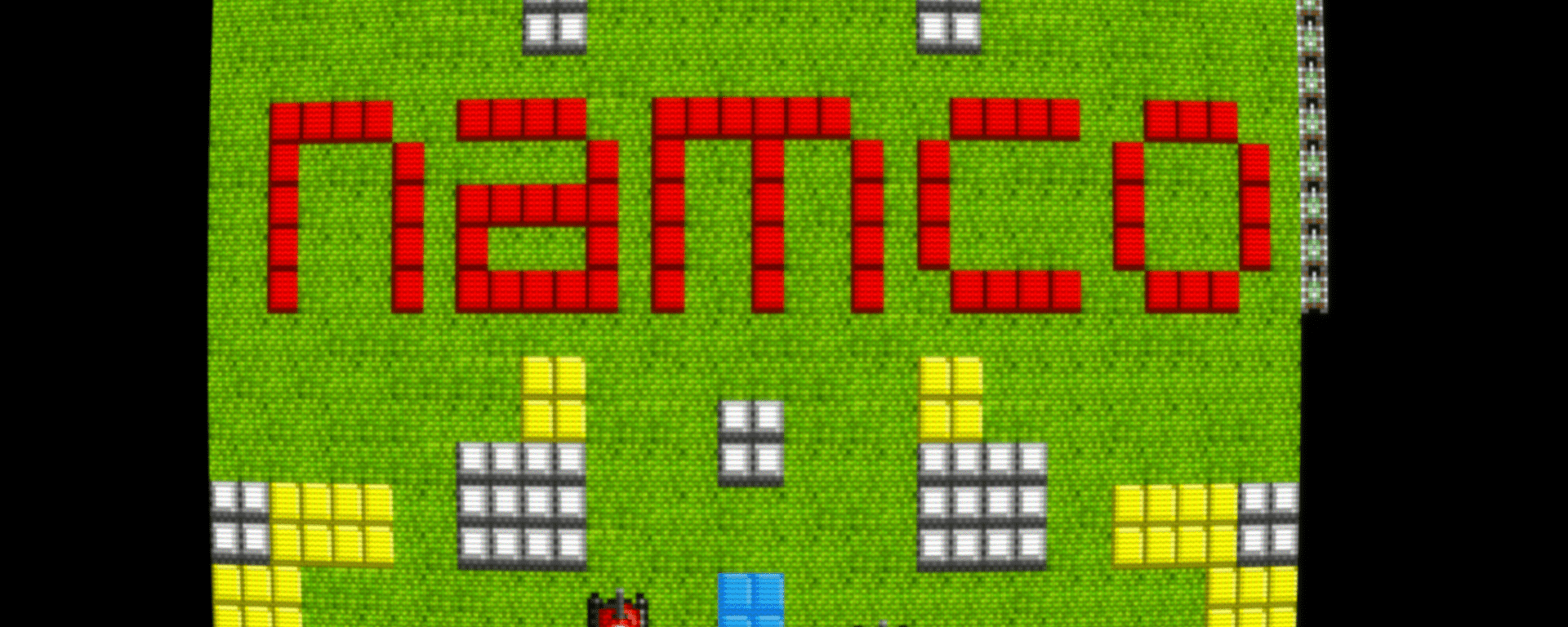
Alliances… Promises… Bargaining… Treachery… Assassinations….
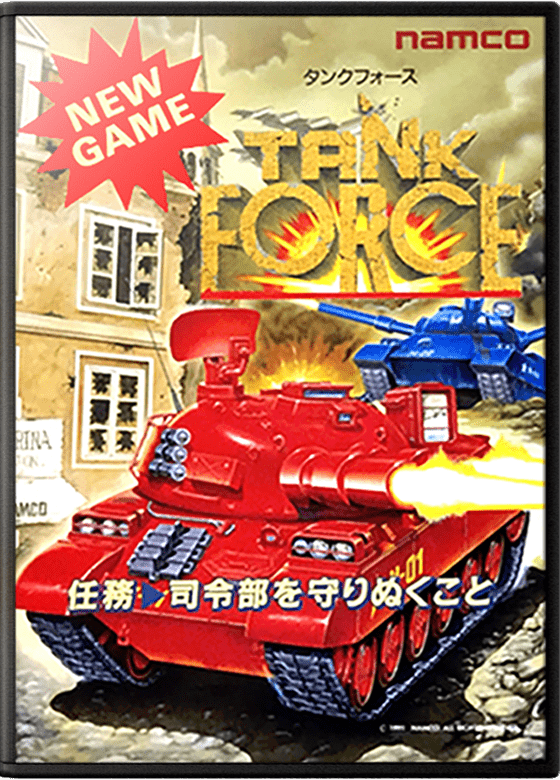
Surprisingly, this isn’t a Crusader Kings game I’m talking about. No, it’s a now-obscure Namco arcade game from 1991: Tank Force.
On the surface, this looks to be something akin to a new take on the formula established by Atari’s Combat and Tank Force’s predecessor games, Tank Battalion (1980) and Battle City (1985). Having played a fair bit of the latter on Famicom with my partner, Tank Force feels like a remaster of that game, expanding on the core concepts.
So, what are the core concepts? Defence and destruction! Each of Tank Force’s stages are single-screen grid-like affairs, with walls of various materials and other battlefield elements. And it’s around these mazes that you’ll drive your tank in four directions, fending off waves of enemy vehicles from attacking your headquarters until a certain number of them are destroyed.

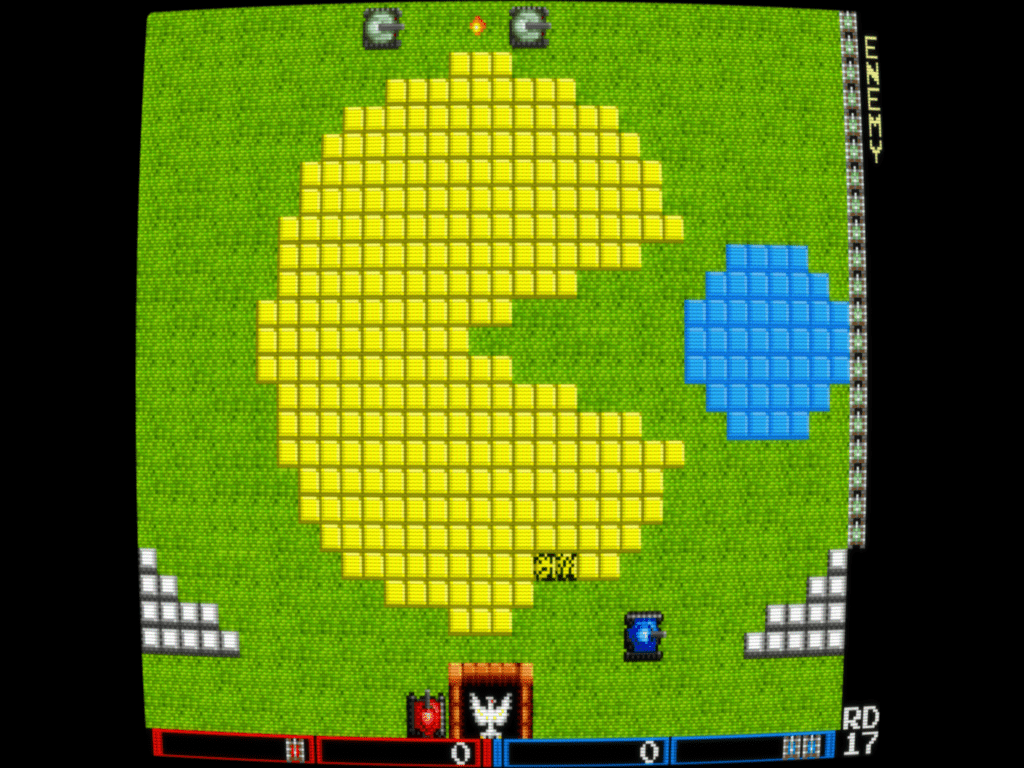
There is plenty of variety in enemy designs, from fast scout cars that will drop sticks of dynamite like mines, faster main battle tanks arriving in convoys, to what I nicknamed Elephant Tanks: monstrous steel beasts with huge trunk-like cannons.
Worry not, however; you’re not ill-prepared for such a relentless assault. Power-ups will spawn that will either upgrade your tank to be tougher or grant you new wonder weapons, such as a ray gun that fires obstacle-penetrating laser beams. Or with the SMALL power-up, shrink your tank down into a tinier, faster version of itself! And be on the lookout for the map-clearing ‘smart bomb’ that will call into an impressive bomber strike!
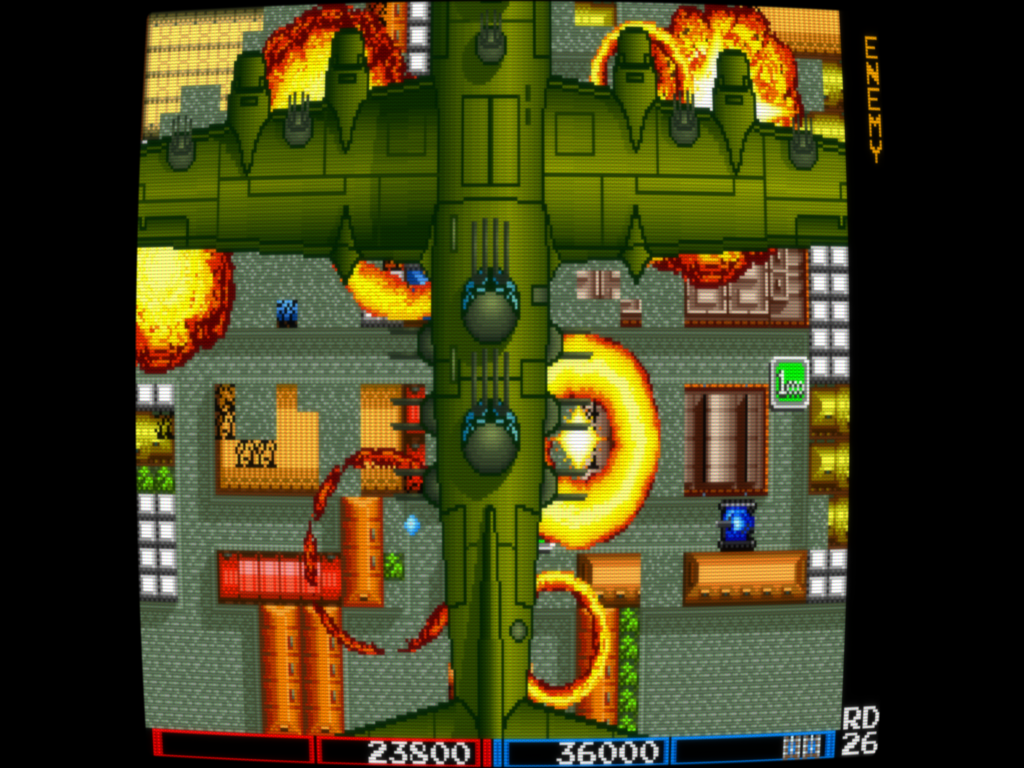
Had there been the option to spawn defence turrets, Tank Force could easily have been an early example of the tower defence genre. The enemies attack you in waves until you deplete a certain number of them and there are natural chokepoints and bottlenecks to be exploited. Some of the terrain is destructible, something that both you and the enemy can take advantage of.
Every few stages, you’ll face a boss. These monstrous engines of war have a few different variations on ‘huge turrets on tracks’ and require different strategies to take down – and sometimes pumping in an extra credit or two! It is an arcade game, after all; gotta munch those quarters!
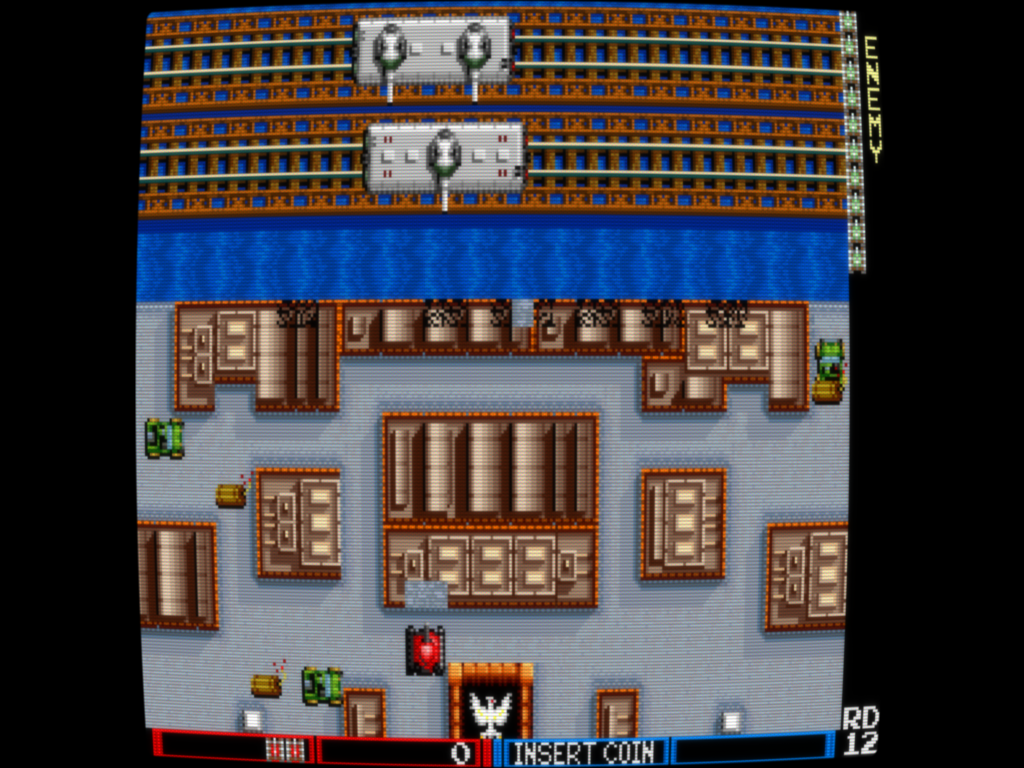
Okay, before we move on to the really good stuff that ties in with the tagline for this article, I’ll praise the soundtrack; it’s surprisingly good, composed by prolific composer Takayuki Aihara under the alias ‘John’. The rousing tunes genuinely help elevate this game to a higher tier and I’ll be listening to the OST away from the game.
The Ace in the Hole
Okay, here’s something I think has been missed in contemporary mentions of Tank Force on its inclusion into the 2017 iteration of Namco Museum for Nintendo Switch: the genius of the game is in the multiplayer mode.
While the game is fun in single-player, it’s when you grab another person (or up to three others in the arcade release outside of Japan) and take them to the battlefield with you that you begin to understand that there’s an additional layer to the gameplay that, on first blush, appears to be entirely cooperative.
Competition.
Wisely, Namco included competitive elements in Tank Force. Whoever scores the highest number of points at the end of the stage is named the victor and gets to plant their flag on the stage map. And when you die, your score count is reset to zero.
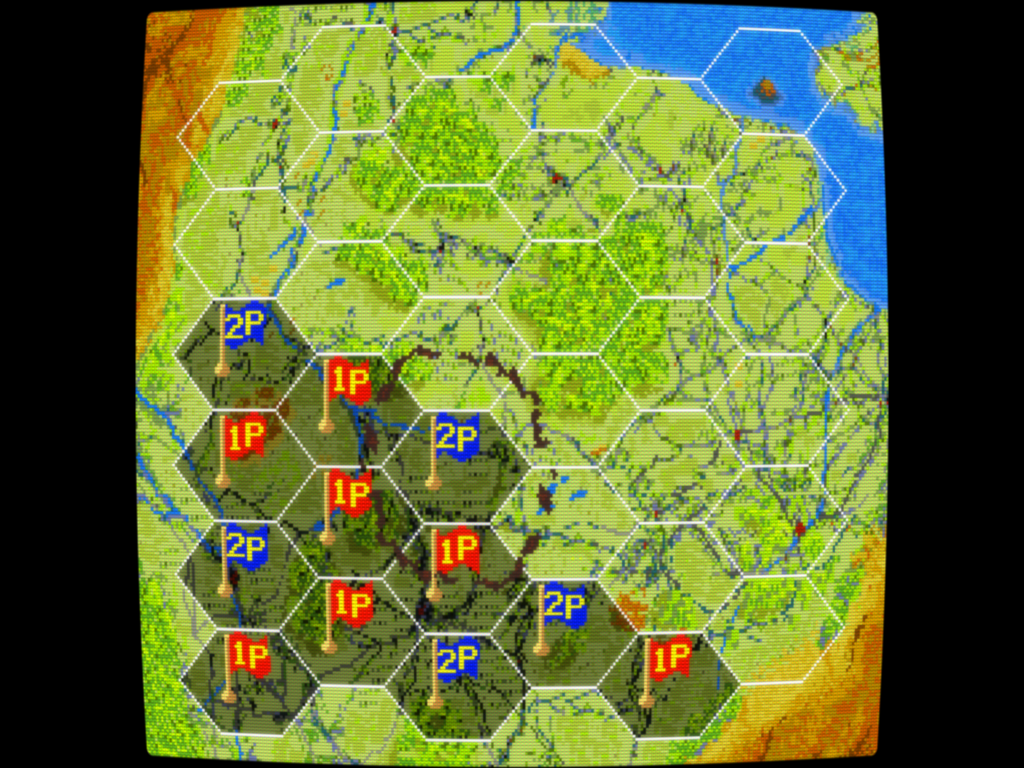
As soon as I realised this during the playthrough with my partner, I began to actively look for little ways to sabotage my erstwhile ally. For example, I would position myself to get a last shot at a boss after she’d whittled it down to flashing red. Or dash in to grab the last kill after she died and her score counter got reset. And to enable your rivalry and acts of sabotage, Namco included friendly fire in the game. Although shooting your ally won’t damage them, it will however shove them aside a little bit with each shot – perfect for giving them a traitorous nudge into the path of enemy fire!

This design choice elevates Tank Force into a multiplayer experience of note. And is so easily missed if you only play it single-player. Kit and I ended up bargaining with one another, calling temporary ceasefires on difficult levels, all the while keeping a count of our flags – and looking forward to an opportunity for a timely backstab.
Of course, in the arcade in ’91 and forking over coins to play, this might have caused some genuine bad blood between siblings or friends. But I can imagine it also fuelled friendly rivalries as blue and red flags competed to dominate the stage map.
Tank Force is a great little game and it was such a pleasant surprise to realise there was an extra wrinkle to its game design after going in blind. It’s easily playable on MAME in addition to having that Namco Museum (and Wii Virtual Console in 2009!) release, so I heartily recommend grabbing a friend and giving it a play.
Happy hunting!
 Scanline Artifacts