


Dare you tread the deadly passages of Castle Eternity under the gaze of the fiendish Magister?

A Revolutionary Foundation
CASTLE MASTER was developed by Incentive Software and published by Domark in 1990 for DOS PC and various 8 and 16-bit home computers. Incentive had enshrined themselves in computer game history a few years earlier in 1987 through the development of the ‘Freescape’ graphics engine that debuted in Driller.

It’s via an upgraded version of its engine, Freescape+, that Castle Master draws the player into its atmospheric three-dimensional world. I first played it as a wee nipper on Commodore 64 not long after release. And though I didn’t know it at the time (I’m not even sure if the term had been coined yet) it would have been my first encounter with a graphics engine. Incentive don’t use the term themselves, but it did perform all the functions of a proprietary 3D graphics engine (and was one of the earliest!), being used for several of their games and all having the same look and feel due to this shared solid geometry-pusher. They also published the Freescape engine commercially in 1991 as the 3D Construction Kit.
Inside the Box
We have the Commodore 64 version (the same one I had back then) of Castle Master and its expansion pack sequel Castle Master II: The Crypt. It’s handsome packaging, with vivid colours, evocative artwork by David Wyatt, and a glossy finish.


Inside, you’re presented with the game on a floppy disk or cassette tape and an equally glossy manual. Sadly, no map! I would have loved a fold-out paper map of the Castle, but then exploration is the name of the game and there is a basic one of the immediate surrounds of the Castle Eternity inside the manual.
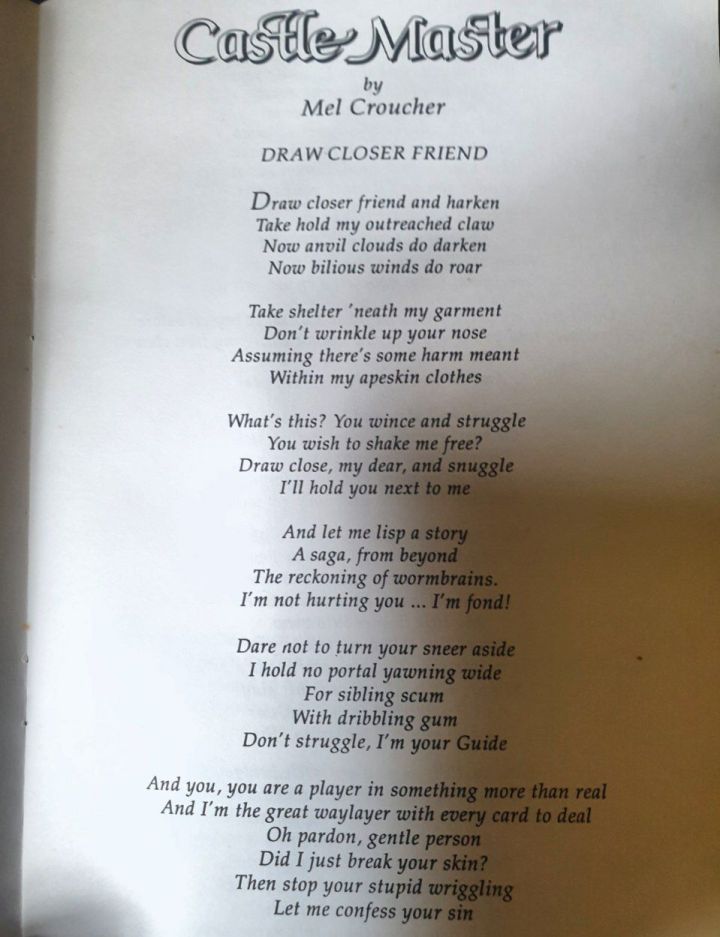
Castle Eternity! Now there’s a name with oomph. Most of the manual is devoted to the backstory of Castle Master, something that intrudes only lightly upon the game itself. Penned by 8-bit computer scene legend and industry pioneer Mel Croucher, Mel weaves quite the evocative tale with a poem that sprawls across twelve A5 pages, all delivered with a menacing undertone. In a 2021 Retro Gamer Magazine interview, Incentive head honcho Ian Andrew (who penned the Driller introduction above) stated that he wanted to add value to Castle Master’s packaging via gothic horror poetry.
A Quest to Rescue a Princess… Or a Prince.
When you first fire up Castle Master, you are greeted by one of my favourite things: the piece of music composed by Matt Furniss that serves as both the title screen and in-game tuneage. I’ve got it playing right now for mood music as I tap this out. And even though it was the C64 version I first played and still enjoy its chiptune-ey rendition, it’s the Amiga one that sticks in my head the most these days.
Next up, you choose your protagonist. This is where I will lavish praise on Incentive for offering a gender option, something I’d never encountered before in a game until that point. And should you choose to play the Princess, it’s not yourself that needs to be rescued but the Prince – your brother.

For the era, this is an unexpected degree of gender equality, though I’m unsure if it was intended to make a statement. Ultimately, it is a cosmetic choice as neither has any advantages over the other (no the prince being stronger and the princess being faster here!) but it is appreciated nonetheless. Choosing one will see the other scooped up by a dragon and carried away to Castle Eternity into the clutches of the villainous Magister!
Welcome To Castle Eternity. Stay awhile… Stay FOREVER!

As you can see from this somewhat askew photo of Castle Master running on our Amiga 600 via Gotek, you’re presented with a first-person perspective of the world framed by both cosmetic and useful HUD elements to keep the frame rate moving at a sufficient level – especially on the 8-bit versions. You move around its 3D medieval fantasy world of castle walls and creepy catacombs with the keyboard or the joystick. And via a set of key commands, you can look around, crawl, run, and walk. All will be needed to successfully traverse the environment.
The world through your adventurous eyes is rendered in filled polygons. On C64, the frame rate is, well, it’s about 1 FP every three S. It’s SLOOOW. But it does lend the game a methodical pace that some might actually prefer. On the Amiga version pictured above, it actually runs too fast on anything above an A500/600. Playing Castle Master on an A1200 or accelerated Amiga will see you zoom across the world at high speed and hazards and enemies move way too fast. And even the Whdload version with speed options set to their slowest is still too fast. If you’re emulating, run Castle Master on OCS/ECS config for the best and intended experience.
Castle Master is a first-person explore ’em up with some combat elements. As you delve into the polygonal world of Castle Eternity, you’ll encounter spirits in some rooms. The screen will flash and your health (represented by dumbells) will begin to slowly drain. Hit space and you’ll switch to a crosshair and combat mode. Your arsenal consists only of a seemingly unlimited number of stones – something that Ian Andrew later lamented as he would have preferred more weapons and combat elements. But, throw stones at the spirits enough times and voila, the room is clear, so they’re pretty lethal things! It can often be a game of hide and seek to find out where the stationary spirits are hidden, as sometimes they resemble mice or just different-coloured textures, while other times (especially in the 16-bit versions) they’ll be moving around or flying about and it becomes a test of reflexes to take them down.

There’s no in-game map, but the layout of the castle is fairly intuitive and rooms are named, so building up a mental one isn’t too tricky. Making a paper map is still recommended as you’ll frequently backtrack to previously visited areas as you pick up keys that open up locked doors that you couldn’t previously pass through. Along the way, you’ll find health-restoring wedges of cheese (delicious!) and riddles on frames on the wall that add a Knightmare feel to the game. In some ways, Castle Mastle feels more like a Knightmare game than the actual ones we got!

Concluding Thoughts
Castle Master was one of the first games I ever played on C64 and has remained lodged in my heart ever since. I was deep into Knightmare, Games Workshop’s DungeonQuest, and Milton Bradley’s HeroQuest at the time, so it really vibed with me. It felt like I was actually exploring a spooky old castle, constructed from what was very likely the first three-dimensional graphics I ever clapped eyes on.
I’m happy to report that it still holds up well and provides an experience that’s pretty unique for the time. It’s not a dungeon-crawling RPG so doesn’t blend in with the swelling crowd seeking to cash in on Dungeon Master‘s success. If released today with some additional QoL refinements, I could see it doing well as a lo-fi indie haunted castle exploration experience.
As previously mentioned, Castle Master received a sequel the same year: The Crypt. It’s more like a standalone expansion pack than a true sequel as it runs on the same engine and doesn’t contain any new gameplay elements. I’ve not nearly played it as much and have never finished it, but if you want more of Castle Master, then there it is. And more of a good thing is never a bad thing… right?
Happy Exploring!
 Scanline Artifacts