

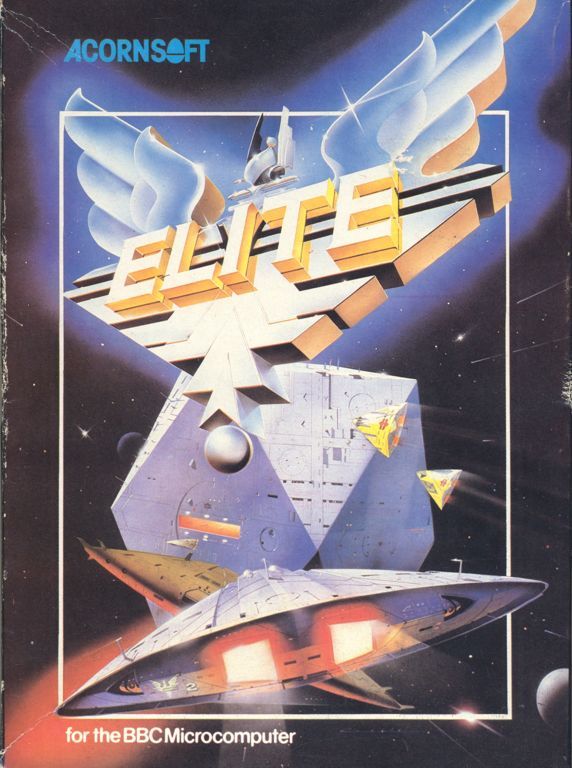
Strap yourselves in peeps, as we’re going on a whirlwind space adventure across the galaxy for this article; it’s the 40th anniversary of the release of the original BBC Micro version of Elite.
Points of Origin
Ian Bell and David Braben were only just leaving their teens when they first started work on the seminal Elite in 1983. For the UK bedroom coders scene, this was hardly uncommon; the microcomputer business boom floated on a sea of young hopefuls furiously coding away on ZX81s, C64s, and ZX Spectrums. For them, however, there was only one machine: the BBC Micro.
“The BBC B is a good machine to program on. It’s certainly the best development machine around, far better than the Spectrum 48K or the Commodore 64.” – Ian Bell.


The pair were already working on space games (Freefall and Fighter) when they met at Jesus College; comparing notes they discovered that they could instead pool their talents, combine their ideas, and make one game rather than two. And what had started life as a 3D arcade blaster inspired by Star Raiders morphed over the two years of development on Elite into an epic space adventure with a backbone of space trading. Inspirations included Star Wars, 2001: A Space Odyssey, and the works of Larry Niven and Isaac Asimov. Another quoted inspiration that will immediately feel obvious to anyone who has played it is Traveller from GDW. In fact, the default Commander name in Elite is ‘Jameson’ – the same as the one Traveller used back then in its rulebooks. Ian Bell claims Traveller is indeed its origin while David Braben denies it, so it’s fair to say that it’s a disputed bit of trivia.
“It’s a good name, and it’s got seven letters, which is the maximum you can use for identifying your commander. Also, in Traveller (a science fiction role playing game, like Dungeons and Dragons only in space) Jameson is the name given to the sample character used to show how to create characters.”
Ian Bell had already been coding Freefall for Acornsoft, so after being turned down by a different publisher, they approached them and pitched Elite. It’s telling of the humble origins of the microcomputer scene at the time that Acornsoft was concerned that two coders would do more harm than good than a single one per game as was common then. But after demonstrating their docking sequence, the duo swayed execs enough to be granted a £1000 advance – and a publishing deal with a 7.5% royalty rate.
Now Arriving at Lave Station
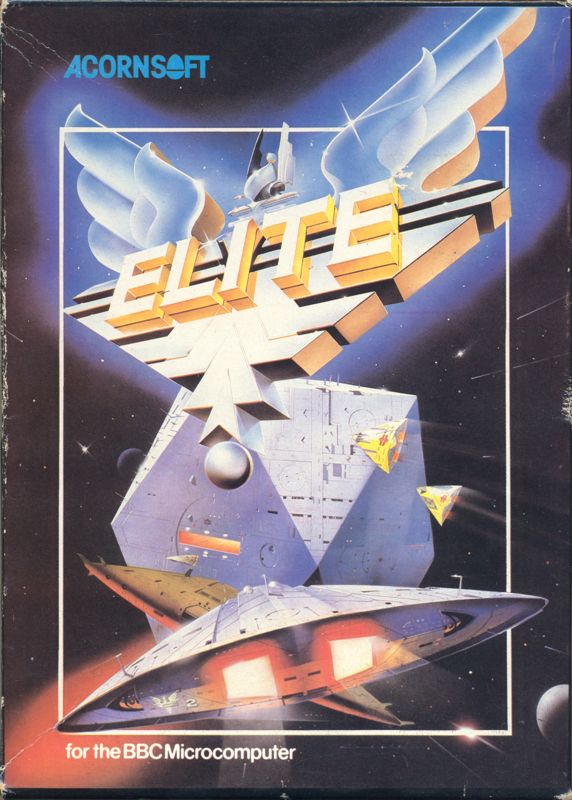
Elite rolled out onto store shelves on September 20th, 1984 – the very same day forty years later that I’m now typing these words. Priced at £14.95 for the tape version and £17.95 for the floppy disk, Acornsoft went all out on making it a marquee event with a £50,000 marketing campaign and a handsome box stuffed with physical goodies. Not only did you get the game, but you also received a ship recognition chart and three manuals, one of them a novella, The Dark Wheel, penned by Robert Holstock.
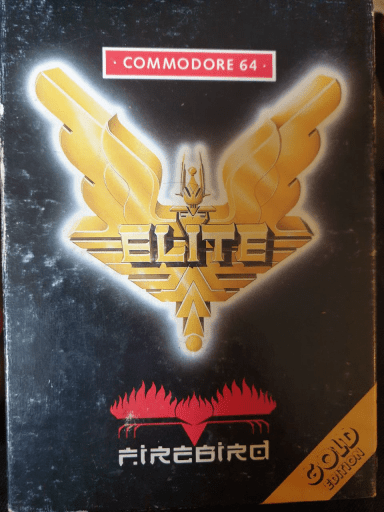
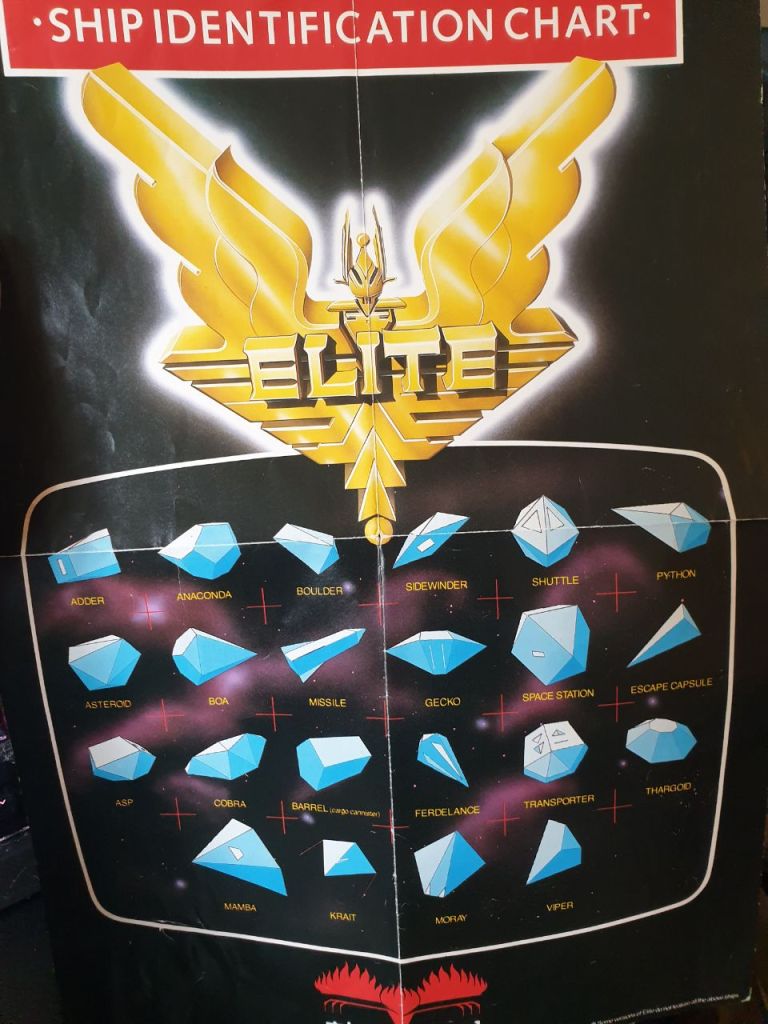
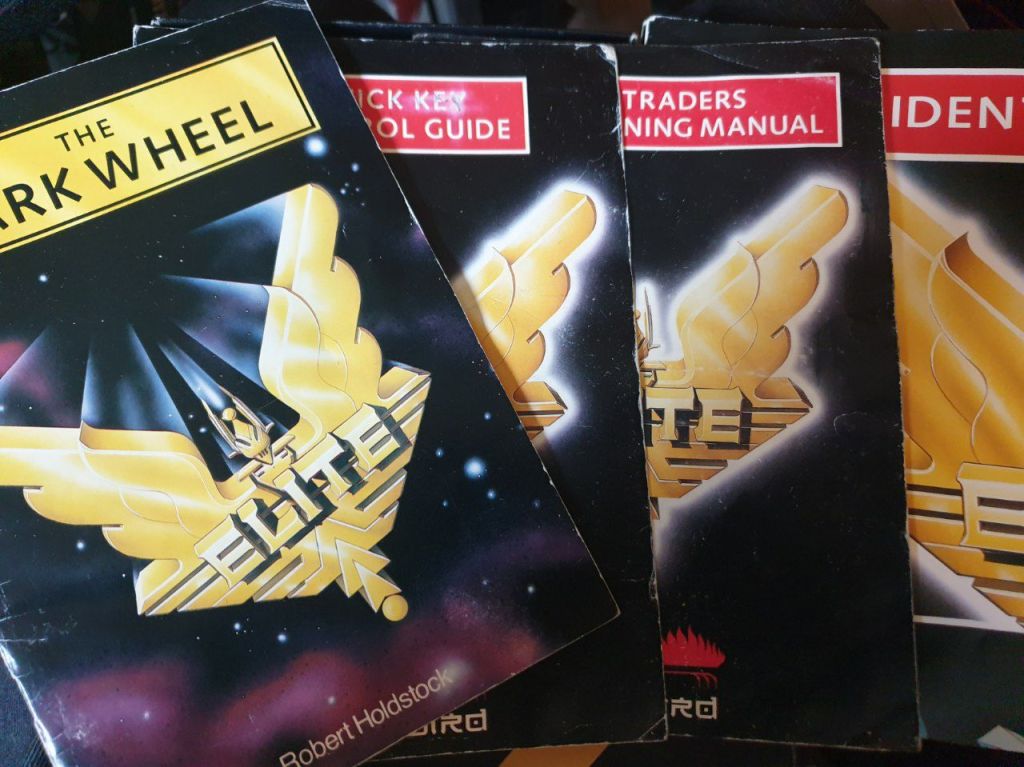
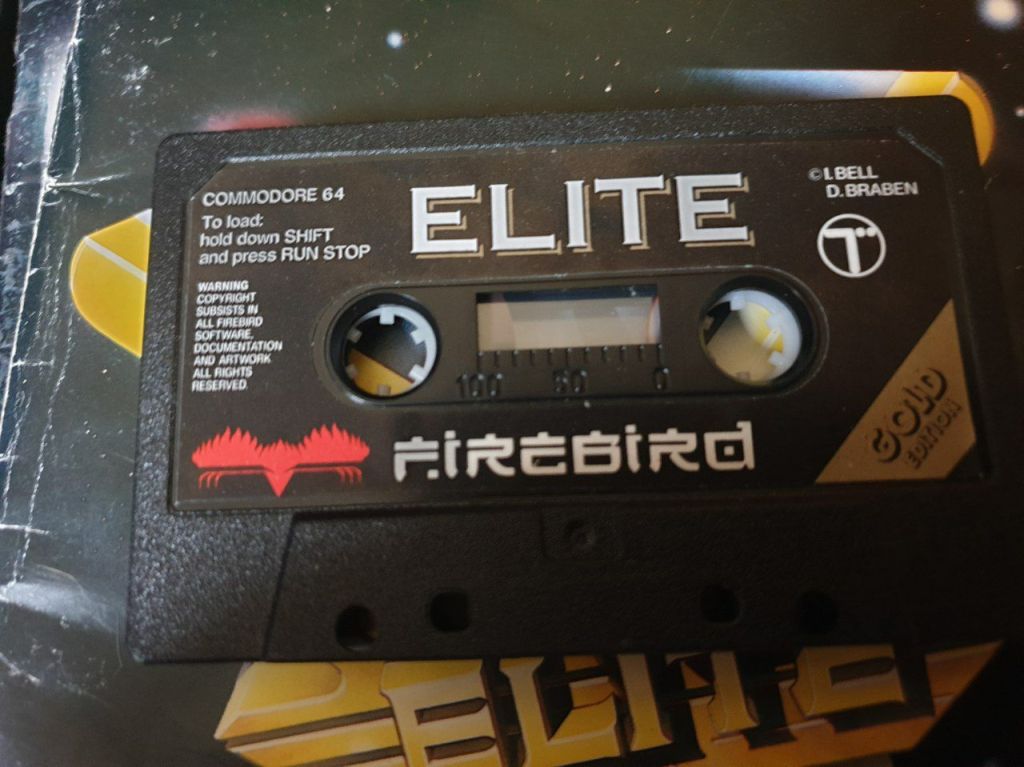
The version seen above is my own copy of the Commodore 64 version released a year later in 1985, but it’s comparable in contents and a piece of history I’m very glad to own.
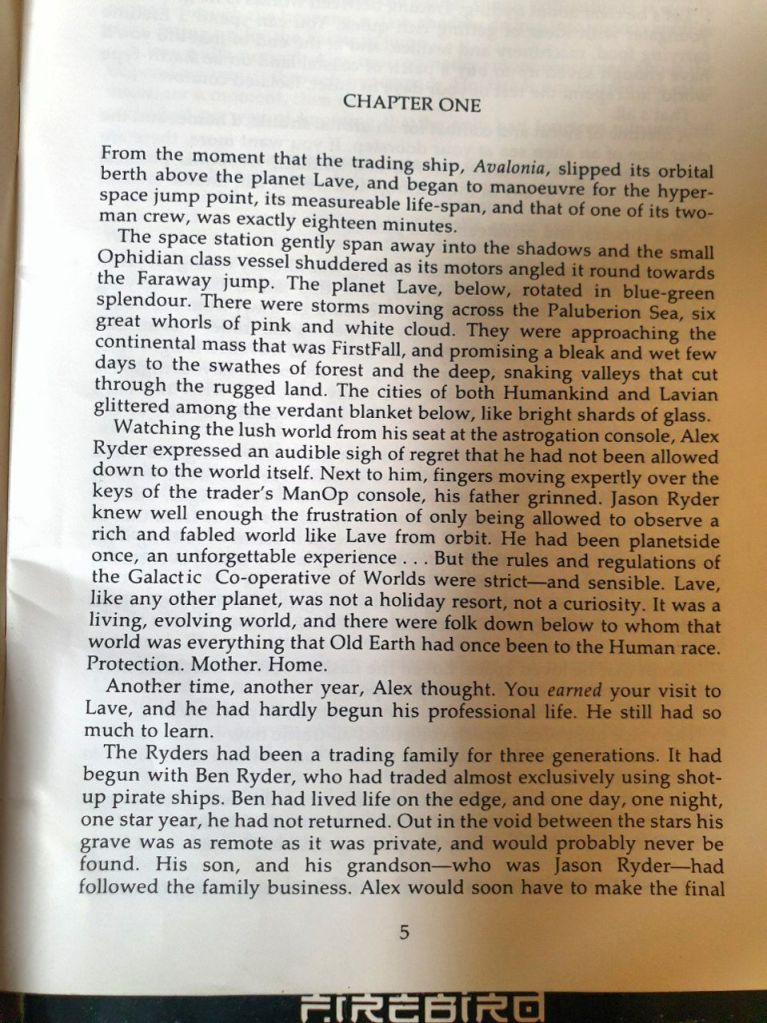
The Dark Wheel is a wonderful worldbuilding fluff book, evoking images in your head of this distant future galaxy to fill in the gaps where primitive wireframe graphics fall short. One detail of this iteration of the Elite universe that would be retconned by the time of the sequel, Frontier: Elite II, is that space traders are not commonly allowed on other worlds and are restricted to the orbital stations. Why? Because they’re living worlds in their own right, not tourist attractions to be gawked at. It also neatly provides a lore reason for why you can’t actually land on planets in Elite. This coupled with the sheer effort of managing multi-vector, three-dimensional space traffic and the perilous nature of hyperspace travel lends spaceflight in the original Elite ‘verse an exotic, almost mystical flavour. None of this actually comes through in the game itself, you simply push the hyperspace jump key, but it’s appreciated all the same for that flavour.
The Space Traders manual serves as both a gameplay manual and another source of worldbuilding lore. And again, if you’re familiar with older Traveller sourcebooks and ship illustrations, you’ll get a feeling that Marc Miller’s own space trading-focused epic served as no small inspiration.
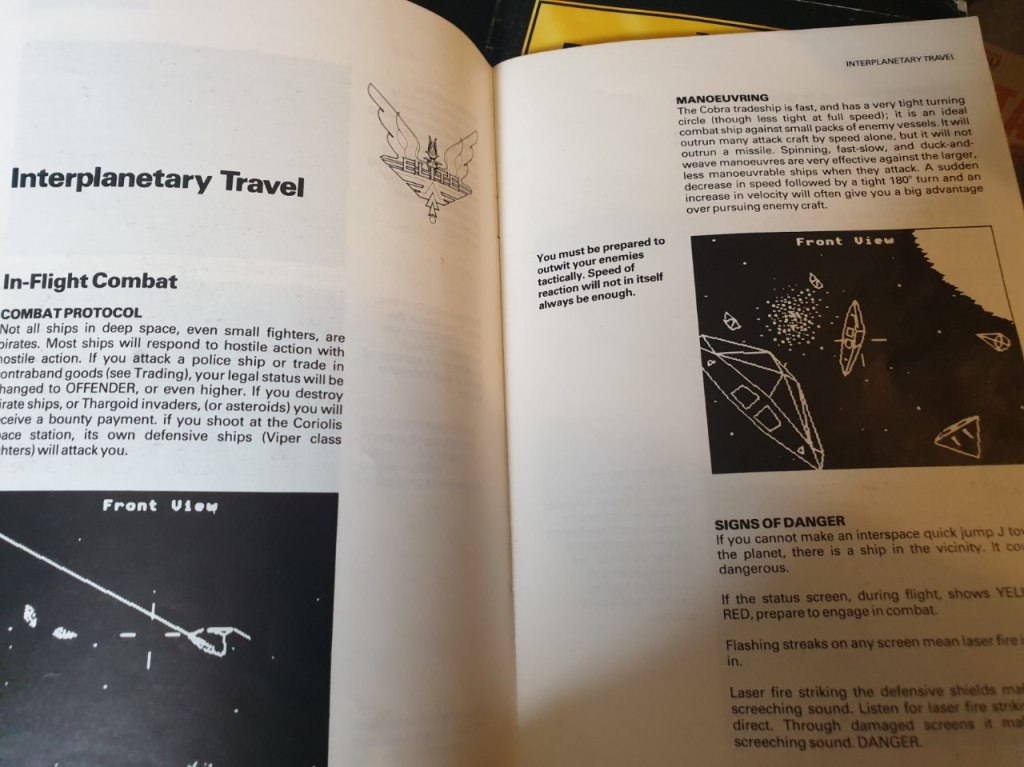
It’s a Space Trader’s life for me!
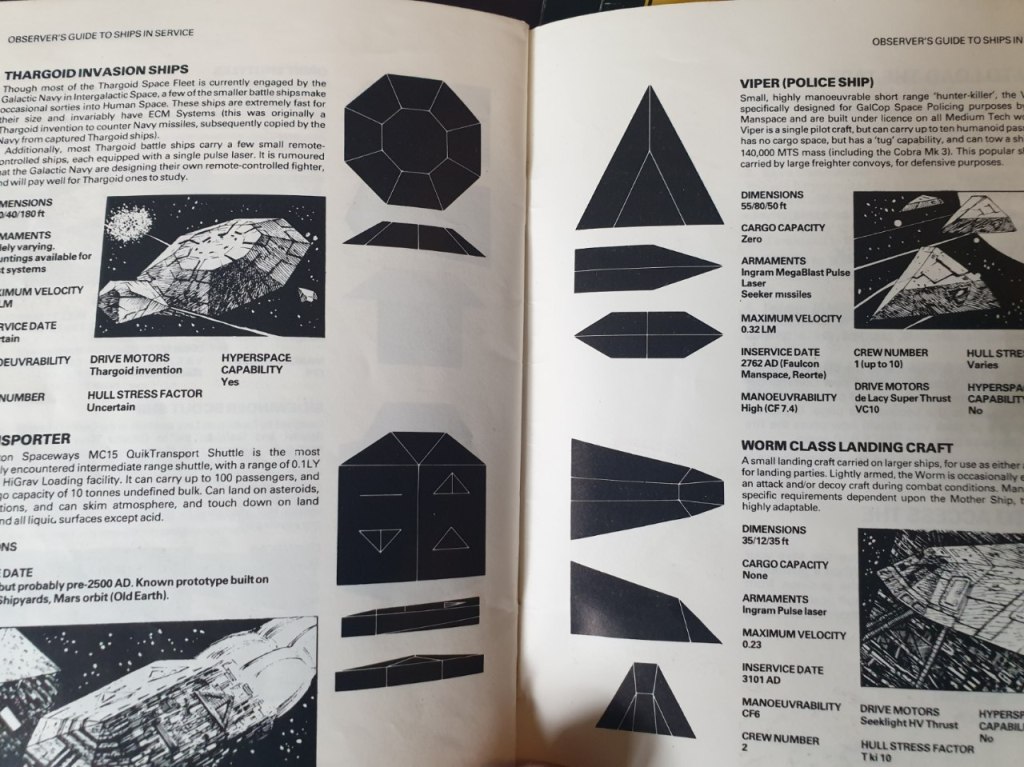
When you load the game, you’re greeted with one of the icons of Elite: a gently rotating wireframe spacecraft, a Cobra Mark III. As you can see from the Ship Recognition Chart above, the majority of Elite’s spaceships have a reptilian naming scheme; Cobra, Viper, Adder, etc. And here in the ships we see technical limitation lending itself to lore. The wireframe models needed to be blocky abstractions, so the in-universe design of the ships reflected that.
It’s in the cockpit of one of these ‘snake-ships’, the Cobra Mark III, that you start your adventure. And it’s the only ship you’ll pilot, so get comfortable! And with just a hundred credits in your bank account, your initial options for the path to fame and fortune are slender. They also form a moral backbone for your own Commander; will you trade in narcotics? Will you indulge in the slave trade?
Elite’s universe is vast for the time. Thanks to some clever procedural generation and the use of machine code and assembly language rather than BASIC, eight galaxies of 256 worlds each were implemented and crammed onto a single floppy disk or tape. Every world is different with individual government types, dominant lifeforms (human or myriad alien), primary economies, and tech levels, all affecting the price of the goods they have to offer or will buy from you. It’s through this implementation of supply and demand on a galactic scale that you’ll make your fortune, turning one hundred credits into a thousand, then ten thousand, and then your first million – with a lot of effort and no small amount of risk.
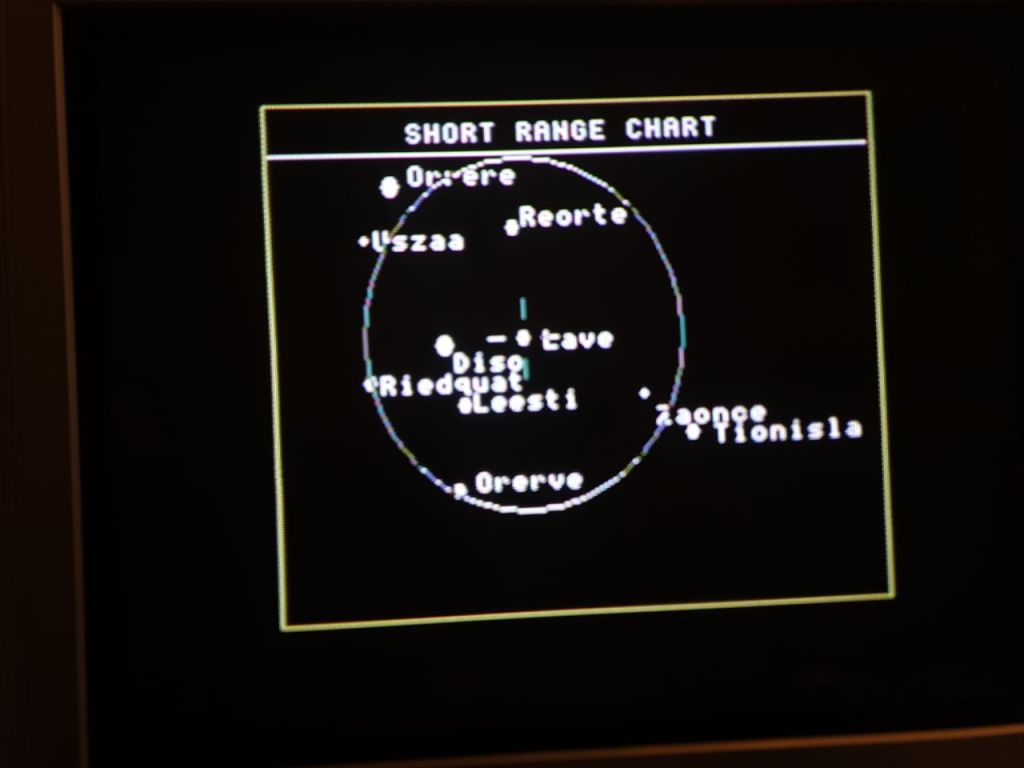
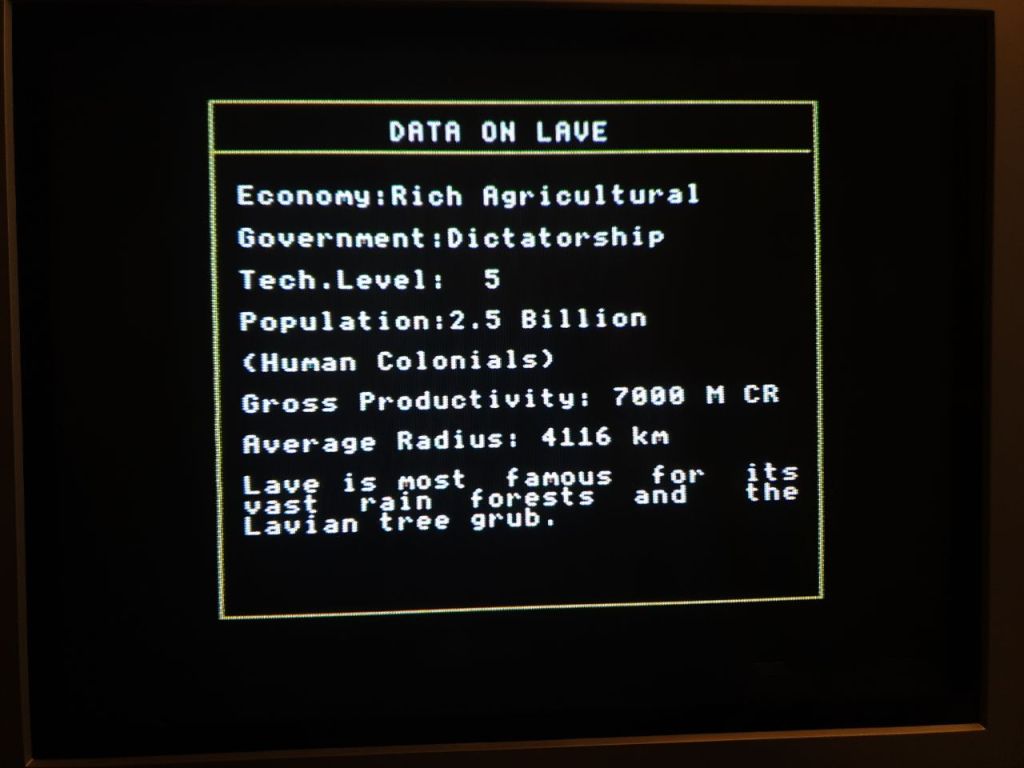
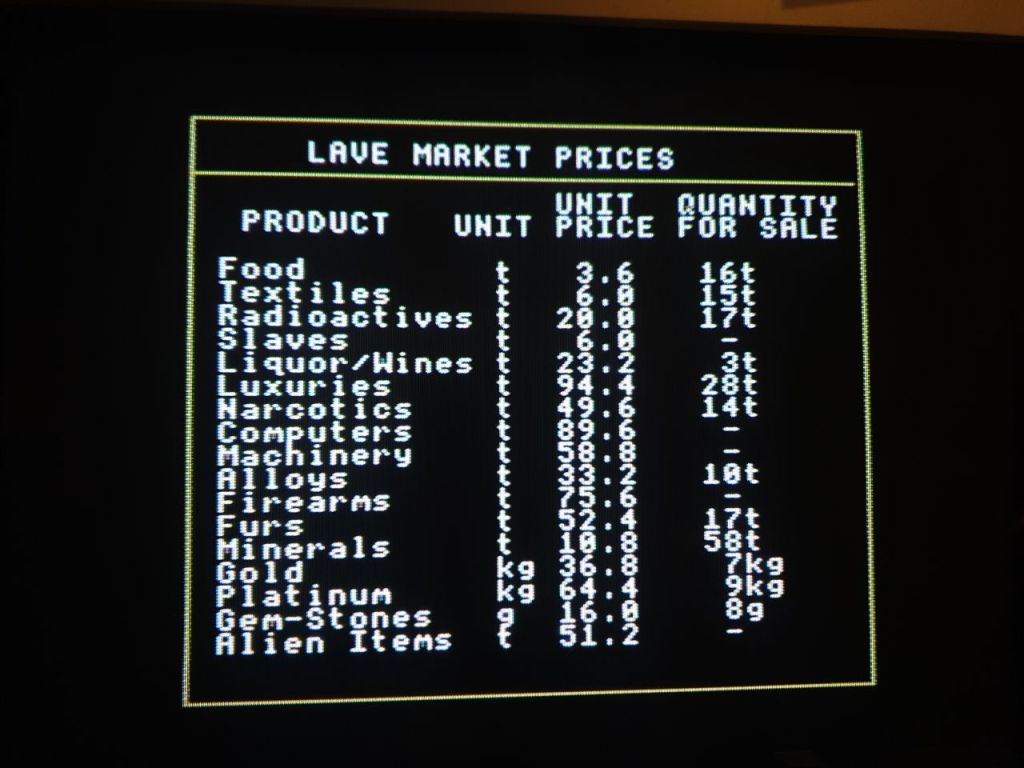
Avast ye! Hand over ye Computers and ye Luxuries!
Other games had already attempted to model space trading, even as far back as 1974 with Star Trader, but none had attempted to do what Elite did – marry it with twitch-based space combat. As previously mentioned, Elite began life as simply a space combat game; the trading elements were added on during its development.
Plying the spaceways alongside you are a myriad of NPC ships – including pirates! Carry cargo of high value and you’ll often have to defend it from pirate ships in dramatic dogfights, your ability to jump away nullified by the mass-based physics of the hyperdrive. Run afoul of GalPol, the Galactic Police, and you’ll be forced to tackle their deadly Vipers, some of the most feared ships in the galaxy.
Most feared are the Thargoid Invasion Ships. These extra-dimensional alien invaders will interdict you in hyperspace itself, or ‘Witch Space’ as it’s commonly known, and rip you back to reality. These encounters will keep you on the edge of your seat, with even the most routine trading run with a hold full of the finest Lavian Tree Grub Sausages having the potential to become a deadly fight for survival.
Even docking with a station comes with its own risks, thanks to the rotation-based flight model used in Elite and needing to thread your ship through the proverbial needle of a docking slot. Many players will meet an abrupt end to their early space trader career impacting against the hull of a rotating Coriolis starport until they master the art of docking successfully.
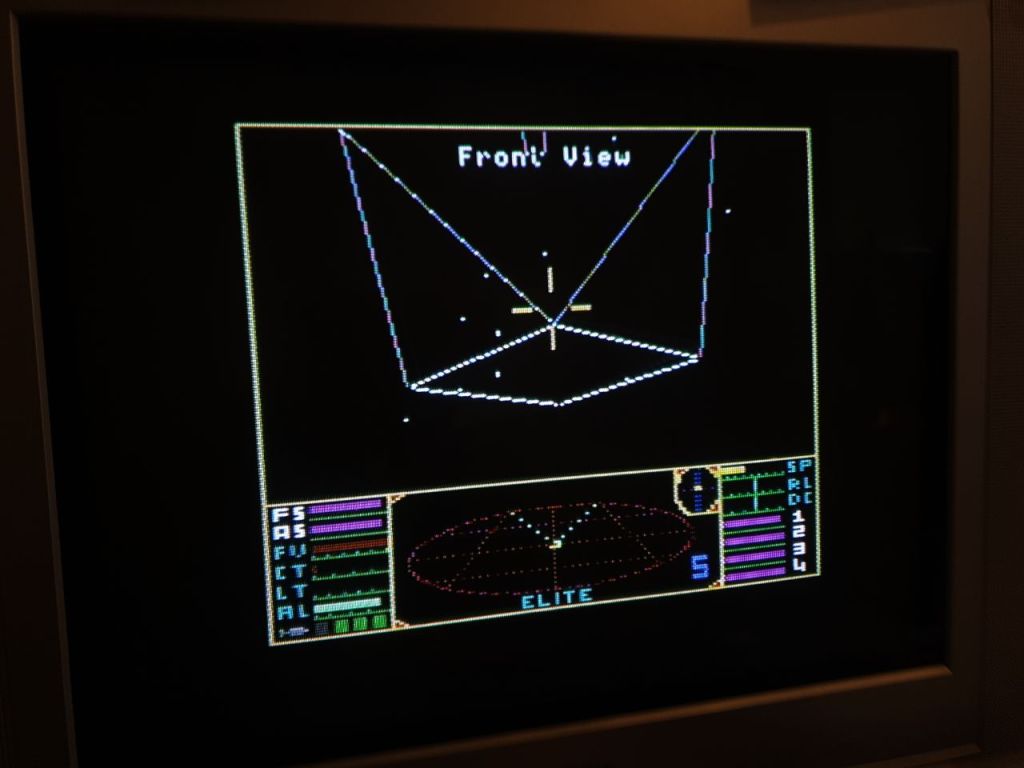
It’s this risk-reward gameplay loop that made and still makes Elite such a compelling game. Especially if you decide to become a space pirate yourself and start attacking and scooping up the cargo of hapless merchanters. And however you take down ships, whether it be through bounty hunting, defending yourself against pirates, or repelling Thargoid invaders, you’ll slowly climb up the ranks of the Elite Federation of Pilots, granting you a title ranging from Mostly Harmless all the way to the vaunted ELITE status from which the game takes its name. Acornsoft even added its own incentive to grind your way to the top with a competition as part of their marketing campaign, pitting those that reached ‘Dangerous’ against one another.
Did Braben and Bell ever attain Elite ranking themselves back then? “Actually,” admitted Ian in a magazine interview in early 1985, “we’ve never bothered — writing games is much more fun than playing them.”
Critical and Commercial Success
In that same January 1985 magazine interview I pulled photos and quotations from, Ian Bell reports that Acornsoft had already sold 20,000 copies of Elite – no small feat back then, and estimated sales of 100,000+ as it moved onto other platforms. Reactions from early gaming magazines from the time were universally positive, with BeeBug magazine calling Elite an “AN OUTSTANDING NEW GAME FROM ACORNSOFT” and a masterpiece of programming. Computer Gaming Weekly rated it five TV screens out of five, their highest mark, praising its “Superb 3D Graphics” as it “blurred the lines between arcade and adventure.”
As ports to C64 and other computers made their way out to the world in the next few years, its star would only continue to rise higher.
My Own Experience with Elite
I never actually played the original version of Elite on Beeb back in the day, nor the C64 one. The first version I played was the Commodore Amiga version of Elite Plus, an enhanced DOS and 16-bit home computer port released in 1991. Programmed by Chris Sawyer of Rollercoaster Tycoon fame, this seems to be something of a controversial version, garnering mixed reviews at the time and being likened to the colourisation of an old classic black-and-white movie.
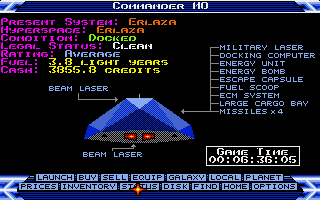
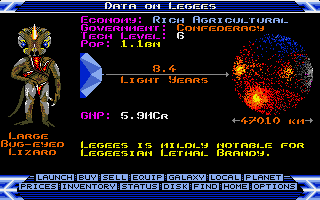
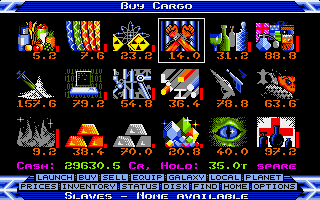
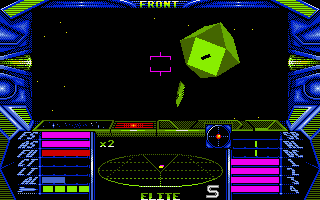
I poured a lot of hours into Elite Plus, so when the sequel, Frontier: Elite II, was announced, bigger and bolder than ever before, I was unbelievably hyped!
Docking Clearance Granted, Commander. Welcome Home.
So here ends my little tribute to this pioneering game and popularizer of space trading games. Happy Ruby Anniversary, Elite, and thank you for all the wonderful space adventures you’ve given me and for those games that were inspired by you.
Oh! And check out this absolutely wonderful promo produced by Acornsoft at the time, it’s so inspiring!
Research sources for this article included Micro Adventurer magazine and Popular Computing Weekly. Non-photographed screenshots courtesy of MobyGames.
 Scanline Artifacts
One thought on “Four Decades of Waltzing the Blue Danube – Elite at 40”