

Space… The Final Frontier. These are the voyages of the Starship Singleton. Its mission: To explore new frontiers in space adventure immersion, seek out new bytes… etc.
Setting Sail from Starbase Atari
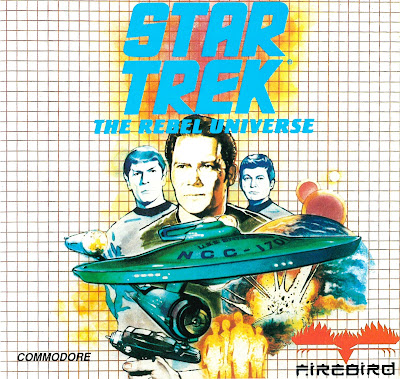
Star Trek: The Rebel Universe set forth on a voyage to Atari ST space in 1987, followed by excursions to the Commodore 64 and DOS PCs the following year. No Amiga version, sadly!
While the Atari ST version is technically superior (it even has voice samples!), it’s the Commodore 64 port I’ll wax lyrical about in this article as it was the version I first played in 1989 and have the most fondness for – and my first-ever Star Trek game!
Published by Simon & Schuster in North America and by Firebird in Europe, The Rebel Universe puts you in the Captain’s Chair of the Enterprise. Then, just as you’re getting comfy, Starfleet tasks you with a deadly mission:
Begin transmission: Starfleet Command directive 12-QZ-63788
To: Captain James T. Kirk, USS Enterprise
Priority one
For some time, Starfleet Command has designated the region of space within the Sagittarius Arm as out of bounds to all United Federation of Planets vessels. The reasons for the isolation of this “quarantine zone” have, until now, remained strictly classified.
Within the past few months, twenty Federation starships have entered the quarantine zone. All twenty have subsequently turned renegade, apparently switching their allegiance to the Klingon Empire. Many of these starships originally entered the zone under Starfleet Command orders to investigate the phenomenon. Each ship, without exception, turned renegade before it could communicate any useful data on the situation. The only relevant information we possess is the last known locations of each of the rebel starships before communications were broken.
Wuh-oh. Sounds serious! And it’s only getting worse, with Starfleet readying desperate measures:
The locations of the starships fall within an area centered on the star Dakiak. This region has expanded at an accelerating rate. Our projections now show this “mutiny sphere” enveloping the entire Federation within a matter of months.
With no known means of stemming this rising tide of mutiny within the Federation, Starfleet Command has been forced to isolate the renegade zone completely by enclosing it within a Klein sphere, an interstellar barrier through which no material object can pass. The Klein sphere will be erected as soon as the Enterprise enters the quarantine zone.
So yeah, this is a galactic emergency in the offing. And it’s not just Federation planets that are within the ‘mutiny sphere’, but also Klingon, Romulan, and independent worlds – raising tensions across the galaxy.
Your mission is to discover the cause of this mutiny (suspicion inevitably falls on the Klingons) and reverse its effects within a five year time period. If the Enterprise succeeds, the thousand stars within the Quarantine Zone will be saved, the Klein Sphere will be dissolved, and the quarantine lifted. If it fails, the Enterprise and its crew are condemned to eternal imprisonment within the renegade zone and Starfleet Command will be forced to make the final adjustments to the Klein sphere and make it a permanent fixture in space.
Command & Control
The game has a unique appearance for the time, using a bespoke graphical user interface and a series of collapsable windows. Move the cursor with the joystick/mouse around the image of the bridge to a crewperson’s portrait and click it and you’ll bring up an overlapping window showing their appropriate crew functions; Sulu for navigation, Spock for scanning and analysis, Uhura for communications, etc.
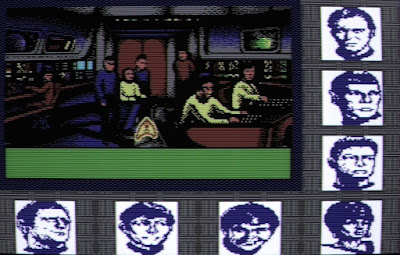
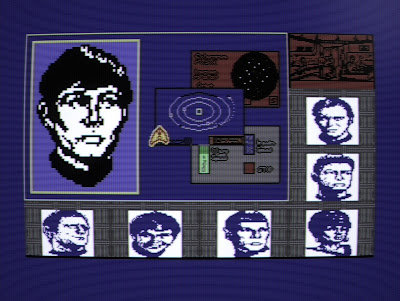
What helps is that the framed portraits will change to previously selected windows, making navigation back to the bridge or anywhere else you need to go back to a breeze. It’s a well-thought-out and visually attractive interface, one implemented by a master of visual interfaces: Mike Singleton of Lords of Midnight fame. Yes, this is one of his games. The first time I learned this, it suddenly made so much sense why Rebel Universe is how it is.
Rebel Universe is effectively an open-world space game. You’re free to travel to any of the hundreds of star systems in the Quarantine Zone and explore them, picking up artefacts and bits of information needed to complete your mission. There are multiple ways of achieving your goal and elements of randomization – another lovely thing that adds replayability. Playing the game really gives you an authentic Star Trek TOS feeling with appropriate sound effects (sampled on the ST) and Scotty warning you that the engines cannae take it, cap’n if you travel at too high a warp speed for too long. And given that travelling from one system to another will eat away at that five-year limit, you’ll be tempted to rocket around at perilously high speeds!
Each star system has at least one planet and will either be Federation, Klingon, Romulan, or Independent. These allegiances govern what kind of ships you may encounter while in-system. You’ll plot spiralling orbital paths to each planet, with Spock at hand to scan and tell you what their special feature will be – for good or bad.
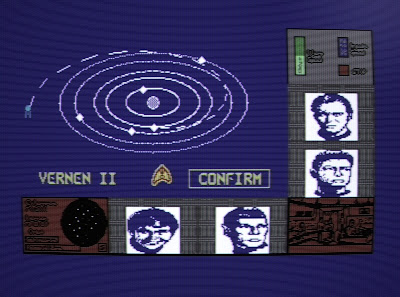
Each planet (unless they’re the rare ‘nondescript’) will have a ‘Planet Type’ that’ll affect your ship and mission. There are roughly two dozen of these Types, ranging from Mesonic Rings and Archive Complexes to Gamma Fields and Dilithium Mining Refineries. Depending on the system’s allegiance, some of these will be beneficial; the Enterprise can seek repairs, be rearmed, and have its dilithium crystals replaced. You’ll also learn helpful titbits of information, clues on how to solve the crisis, and how many enemy ships are within the zone.

Some of the Types, however, will be harmful. Leeching Piles will drain your energy reserves. Contamination Zones will increase the chances of being attacked. Worst of all are Catastrophe Pods. These spaceborne menaces will attach themselves to your ship as you enter a system, accompanied by a telltale sound. Fail to remove them by a specific method within a time limit and they’ll explode, taking down your ship with them!
One of the Planet Types, Life-Supporting, will engage another aspect of gameplay: Away Missions!
We Come in Peace
This gameplay element draws from text and choose-your-own-adventure games and will be where the majority of the puzzle-solving in the game takes place. Beaming down with an away team of six crew (you can pick who), you’ll go through a series of four or five encounters with obstacles such as doors, janitor robots, and generators before you reach the end of the away mission. This can be a beneficial device, an enemy captain, or sometimes nothing at all, a dead end.
Each of the command crew you take with you will have a particular suggestion as to how to resolve an encounter that ties in with their role and personality. Spock will always be more analytical, Chekov will often suggest firing a phaser, Uhura will want to beam signals at it, etc. Kirk, ever eager to take his shirt off and engage in fisticuffs, will often suggest physical force. While initially entertaining as you imagine the scenes in the context of the show, it will eventually become repetitive and frustrating as you’re often just picking what feels most appropriate and hoping for the best. There are no character stats to speak of, so it feels entirely at the mercy of RNG. And if a crewperson is injured because of a poor choice, you’ll have to beam back to the ship, wait in sickbay for them to regenerate health, and then go back again.
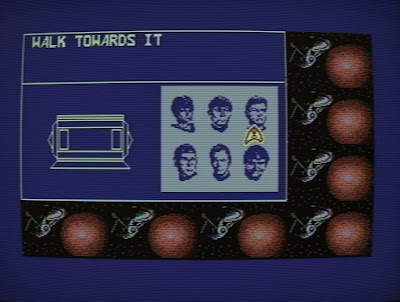
Sadly, there are no first-contact situations or alien diplomacy. Occasionally, you’ll encounter someone who’ll pass on information if you pick the right course of action, but aside from your crew’s status reports, there is no other verbal interaction in the game. This lack of Trek flavour is often one of the biggest critiques I see of Rebel Universe and it’s a fair one. In this regard, Binary Systems’ Starflight is a better Trek game than Rebel Universe!
Lock Phasers and Fire Photon Torpedoes!
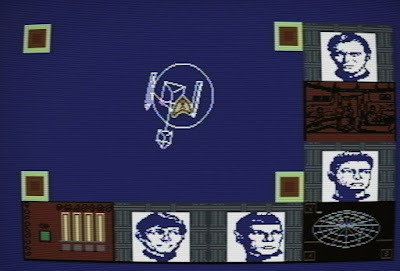
One aspect that Rebel Universe doesn’t lack is starship battles! While initially appearing complex with their rotatable grid and attempts to portray three-dimensional combat, they’re actually pretty simple stuff and little more than a shooting gallery. Using a combination of the grid radar and a crosshair over a wireframe model of the enemy ship, you pew-pew away with phasers and torpedoes. It feels more tactical than it actually is, but I appreciate the effort that went into giving it a Wrath of Khan feel.
Concluding Thoughts
Star Trek: The Rebel Universe still impresses me to this day, especially on C64. While it lacks some of the Trek flavour that Starflight revels in and has elements that become stale and repetitive, It’s nevertheless a well thought out and ambitious TOS-era Trek adventure simulator, one worthy of spending time with.
Watch out for Catastrophe Pods!
 Scanline Artifacts